Fact: United States consumers spend significantly more on potato chips than the government devotes to energy R&D.
Fact: In 2000 the number of foreign students studying the physical sciences and engineering in United States graduate schools for the first time surpassed the number of United States students.
Fact: China is now second in the world in its publication of biomedical research articles, having recently surpassed Japan, the United Kingdom, Germany, Italy, France, Canada and Spain.
Fact: Sixty-nine percent of United States public school students in fifth through eighth grade are taught mathematics by a teacher without a degree or certificate in mathematics.
Showing posts with label change in the academic landscape. Show all posts
Showing posts with label change in the academic landscape. Show all posts
January 6, 2011
The Gathering Storm
December 17, 2010
The slipperiness of empirical truth
I just finished reading an engaging article in The New Yorker, called "The Truth Wears Off." The author Jonah Lehrer talks about a problem that many scientific disciplines face - it's called the decline effect. The decline effect is when well-established and multiply confirmed empirical studies begin to show a reduced effect size or are no longer provable.
One example of this is called the phenomenon of "verbal overshadowing" demonstrated by a psychologist named Jonathan Schooler in 1990. He showed that subjects shown a face and asked to describe it are LESS likely to recognize the face when shown the same face later than those who simply view the face. But Schooler states in this New Yorker article that he has since found it difficult to replicate this earlier finding. He says,
"It was as if nature gave me this great result and then tried to take it back."
One example of this is called the phenomenon of "verbal overshadowing" demonstrated by a psychologist named Jonathan Schooler in 1990. He showed that subjects shown a face and asked to describe it are LESS likely to recognize the face when shown the same face later than those who simply view the face. But Schooler states in this New Yorker article that he has since found it difficult to replicate this earlier finding. He says,
"It was as if nature gave me this great result and then tried to take it back."
December 3, 2010
The one.

Okay peeps, I know that many of you are lurkers at this website (according to the visits from the sitemeter stats). But I want you to come out of your closet and tell me what scientific classical text do you think that every young academic should read? It can be a book, an article, essay, book chapter etc. And I don't want to limit this to biology. Just include the discipline of science when you name the text! You don't have to give your name, just comment anonymously if you're too shy.
November 12, 2010
October 26, 2010
To share or not to share?
Over at Academic Jungle, GMP has a controversial post on sharing code. A scientist requested some code that was used in a published manuscript. She says this in her post,
"I actually replied politely, thanking him/her for the interest and stating that regrettably I cannot share the code. My group develops detailed microscopic simulations of certain physical phenomena. These codes can have wonderful predictive power and take years to develop. Sharing the codes is absolutely not the norm in my field, and there is no way in hell I would share any of my research codes with anyone other than close collaborators and colleagues.
Now most of the responses from commenters are in complete disagreement with GMP and I want to add I believe that it is utterly wrong to deny any request of published data to anyone, if the science is publicly funded.
But before jumping on GMP and calling this "despicable behavior," I think it's important to delve a little more into this issue.
GMP would not be first researcher who has refused to share. According to Heather Piwowar at Research Remix, almost 40% of scientists are not willing to release data. Why? It could be as in the case of GMP, an outright refusal, or because researchers are "not able to retrieve the data."
How many of you who are now well past your graduate work could provide data from a paper in your postdoc or PhD?
I have experienced this problem when I wrote to request data from someone who completed their PhD in the early 90s . The person responded by saying they didn't have a copy of it anymore, but that they could send summary tables from their dissertation. I wanted the original data because I felt that the analysis used at the time was incorrect and sending me the summary tables simply recapitulates the analysis.
GMP's post indirectly raises the issue of do we share data?
First, I define data to include but not limited to cell lines, evolved critters, genetic data, morphological measurements, images, maps, character matrices, seeds, and maybe (with some qualifications), computer code.
I am firmly in the camp of yes, we share data. If it's published, its not yours anymore. (Not that I really think it ever was...but that's another blogpost.)
In an editorial written in the journal Evolution, Rausher et al. (2010) outline the reasons for data sharing. As they highlight, much of our progress in understanding the natural world depends on building upon previously collected data. But too often that original data (not summary stats) is lost because the researcher just moved too many times or technology advances such that the data irretrievable. Who remembers floppy discs or zip discs? I have stuff that I can't access on a floppy and not that it matters, but in 10-20 years when whatever we're using now, becomes useless, how will anyone be able to access that data? An online database would preserve our scientific history.
Researchers typically refuse to share data for many reasons, probably top among these reasons is that they want to publish more papers and/or they want exclusive use of the data. But let's say decades later, after the faculty member retires, a young upstart researcher wants to conduct a meta-analyses on original data. A common data repository would make this young person's life a lot easier. And as Piwowar states in her slideshow called Research into Open Research Data, not sharing data is hurting mainly the young. She cites a survey of doctoral students and postdocs, saying that 28-50% report a negative impact from data withholding on progress, discovery and the quality of education.
Rausher et al. (2010) also suggest that data that is archived and available is more likely to be useful and to be cited more by other scientists. We only have to look to GenBank to see that this repository has afforded many different researchers a chance to use data collected by others to ask very different questions.
A final reason that we should share our scientific data is accountability. Data that is made accessible means that it can be checked for errors. Good data means good science and progress. According to Piwowar, more than half of all papers contain errors, but only 5-10% contain errors that change conclusions. Sigh of relief.
Recently, several journal editors within the ecology and evolution subdiscipline of biology came together to form DRYAD.
Already journals like The American Naturalist (American Society of Naturalists), Evolution (Society for the Study of Evolution), Molecular Ecology, Journal of Evolutionary Biology (European Society for Evolutionary Biology) have become interim partners with Dryad. These journals will be introducing a new data-archiving policy which will state that as a condition for publication, data used in the paper should be archived into an appropriate public database. The policy does, however, allow for an embargo period after publication and for longer periods of restriction at the discretion of the editor.
So what about computer code?
Unfortunately, Dryad is not set up to accept computer code. My programming friends tell me that the main reason coding geeks are reluctant to share code is the licensing problem. Freely available code means that anyone can take your code and use it to make a commercial program that they could then sell for cash. A second reason, I'm told is that computer code is dynamic and changing unlike data that is collected. For computer nerds, it's important that code change and evolve because that makes it better. And really in my field when I think about it, this is true. But, some of that evolution comes because the code is made public. Feedback from the user is essential to finding the bugs or problems with a given code.
In a recent article to Nature, Nick Barnes, a software computer engineer suggests that turning raw data into published papers requires a little programming, meaning that scientists write software. And he argues that yes, it isn't very good because of poor commenting, weird variable names and a lack of indentation. But it works. And if it works it should be made accessible.
But I would ask, all of it? Some of my R code is just a one-off and it isn't really necessary that I archive it. I do, however, have code that is associated with a particular dataset and could be useful to future users. And I would like to deposit my code somewhere and ensure that it was associated with that particular dataset.
Luckily for us in biology, things are improving, we have places where we can access shared code. Often the code is located in websites run by researchers but this means that it is essentially anywhere in the web. What is needed is a single resource where users can find and share code. Well, a new place called The Molecular Ecologist, associated with the journal Molecular Ecology Resources will provide a blog that highlights important papers in the field; list computer programs and other code (e.g. R packages) useful for analyzing genetic data; and a site to discuss methods.
I know it's a lot of work getting your "data" ready for submission - there's the formatting, the organizing, and the worry about mistakes being found or the data being misinterpreted.
But in the end, I feel better for having submitted data to a public repository. After all that blood, sweat and tears, I don't really want my hard work to end up in a black hole.

Photo taken from Website: Astronomy Picture of the Day
Other Sources: Rausher MD, McPeek MA, Moore AJ, Rieseberg L, Whitlock MC. 2010. Data archiving. Evolution. 64-3: 603-604.
"I actually replied politely, thanking him/her for the interest and stating that regrettably I cannot share the code. My group develops detailed microscopic simulations of certain physical phenomena. These codes can have wonderful predictive power and take years to develop. Sharing the codes is absolutely not the norm in my field, and there is no way in hell I would share any of my research codes with anyone other than close collaborators and colleagues.
Now most of the responses from commenters are in complete disagreement with GMP and I want to add I believe that it is utterly wrong to deny any request of published data to anyone, if the science is publicly funded.
But before jumping on GMP and calling this "despicable behavior," I think it's important to delve a little more into this issue.
GMP would not be first researcher who has refused to share. According to Heather Piwowar at Research Remix, almost 40% of scientists are not willing to release data. Why? It could be as in the case of GMP, an outright refusal, or because researchers are "not able to retrieve the data."
How many of you who are now well past your graduate work could provide data from a paper in your postdoc or PhD?
I have experienced this problem when I wrote to request data from someone who completed their PhD in the early 90s . The person responded by saying they didn't have a copy of it anymore, but that they could send summary tables from their dissertation. I wanted the original data because I felt that the analysis used at the time was incorrect and sending me the summary tables simply recapitulates the analysis.
GMP's post indirectly raises the issue of do we share data?
First, I define data to include but not limited to cell lines, evolved critters, genetic data, morphological measurements, images, maps, character matrices, seeds, and maybe (with some qualifications), computer code.
I am firmly in the camp of yes, we share data. If it's published, its not yours anymore. (Not that I really think it ever was...but that's another blogpost.)
In an editorial written in the journal Evolution, Rausher et al. (2010) outline the reasons for data sharing. As they highlight, much of our progress in understanding the natural world depends on building upon previously collected data. But too often that original data (not summary stats) is lost because the researcher just moved too many times or technology advances such that the data irretrievable. Who remembers floppy discs or zip discs? I have stuff that I can't access on a floppy and not that it matters, but in 10-20 years when whatever we're using now, becomes useless, how will anyone be able to access that data? An online database would preserve our scientific history.
Researchers typically refuse to share data for many reasons, probably top among these reasons is that they want to publish more papers and/or they want exclusive use of the data. But let's say decades later, after the faculty member retires, a young upstart researcher wants to conduct a meta-analyses on original data. A common data repository would make this young person's life a lot easier. And as Piwowar states in her slideshow called Research into Open Research Data, not sharing data is hurting mainly the young. She cites a survey of doctoral students and postdocs, saying that 28-50% report a negative impact from data withholding on progress, discovery and the quality of education.
Rausher et al. (2010) also suggest that data that is archived and available is more likely to be useful and to be cited more by other scientists. We only have to look to GenBank to see that this repository has afforded many different researchers a chance to use data collected by others to ask very different questions.
A final reason that we should share our scientific data is accountability. Data that is made accessible means that it can be checked for errors. Good data means good science and progress. According to Piwowar, more than half of all papers contain errors, but only 5-10% contain errors that change conclusions. Sigh of relief.
Recently, several journal editors within the ecology and evolution subdiscipline of biology came together to form DRYAD.
"Dryad is an international online repository of data underlying peer-reviewed articles in the basic and applied biosciences. Dryad enables scientists to validate published findings, explore new analysis methodologies, repurpose data for research questions unanticipated by the original authors, and perform synthetic studies. Dryad is governed by a consortium of journals that collaboratively promote data archiving and ensure the sustainability of the repository."
Already journals like The American Naturalist (American Society of Naturalists), Evolution (Society for the Study of Evolution), Molecular Ecology, Journal of Evolutionary Biology (European Society for Evolutionary Biology) have become interim partners with Dryad. These journals will be introducing a new data-archiving policy which will state that as a condition for publication, data used in the paper should be archived into an appropriate public database. The policy does, however, allow for an embargo period after publication and for longer periods of restriction at the discretion of the editor.
So what about computer code?
Unfortunately, Dryad is not set up to accept computer code. My programming friends tell me that the main reason coding geeks are reluctant to share code is the licensing problem. Freely available code means that anyone can take your code and use it to make a commercial program that they could then sell for cash. A second reason, I'm told is that computer code is dynamic and changing unlike data that is collected. For computer nerds, it's important that code change and evolve because that makes it better. And really in my field when I think about it, this is true. But, some of that evolution comes because the code is made public. Feedback from the user is essential to finding the bugs or problems with a given code.
In a recent article to Nature, Nick Barnes, a software computer engineer suggests that turning raw data into published papers requires a little programming, meaning that scientists write software. And he argues that yes, it isn't very good because of poor commenting, weird variable names and a lack of indentation. But it works. And if it works it should be made accessible.
But I would ask, all of it? Some of my R code is just a one-off and it isn't really necessary that I archive it. I do, however, have code that is associated with a particular dataset and could be useful to future users. And I would like to deposit my code somewhere and ensure that it was associated with that particular dataset.
Luckily for us in biology, things are improving, we have places where we can access shared code. Often the code is located in websites run by researchers but this means that it is essentially anywhere in the web. What is needed is a single resource where users can find and share code. Well, a new place called The Molecular Ecologist, associated with the journal Molecular Ecology Resources will provide a blog that highlights important papers in the field; list computer programs and other code (e.g. R packages) useful for analyzing genetic data; and a site to discuss methods.
I know it's a lot of work getting your "data" ready for submission - there's the formatting, the organizing, and the worry about mistakes being found or the data being misinterpreted.
But in the end, I feel better for having submitted data to a public repository. After all that blood, sweat and tears, I don't really want my hard work to end up in a black hole.

Photo taken from Website: Astronomy Picture of the Day
Other Sources: Rausher MD, McPeek MA, Moore AJ, Rieseberg L, Whitlock MC. 2010. Data archiving. Evolution. 64-3: 603-604.
What is the purpose of a university?
Okay, thanks to those of you for your words of encouragement.
It's in the making. In the meantime, I suggest that you follow Nat Blair's lead and refresh your memories by reading these posts.
Or you could just chew on this quote from Alfred North Whitehead,
It's in the making. In the meantime, I suggest that you follow Nat Blair's lead and refresh your memories by reading these posts.
Or you could just chew on this quote from Alfred North Whitehead,
"The tragedy of the world is that those who are imaginative have but slight experience, and those who are experienced have feeble imaginations. Fools act on imagination without knowledge; pendants act on knowledge without imagination. The task of the university is to weld together imagination and experience."
September 29, 2010
The Mushy Carrot
On Saturday, HippieHusband and I went out for dinner with an old friend of his, Dr.Rappa, a t-t faculty (up for tenure this year) at a "teaching" university. Dr.Rappa looks like he is the hybrid offspring of Mr.Rogers and Frank Zappa. Funny and charming, there is something in his behavior that suggests he is not entirely happy. You know like when Mr.Rogers goes to his closet full of perfectly hung and aligned sweaters and he exchanges the green cardigan for a yellow one. All the while singing in a creepy happy psychokiller qu'est que c'est voice, "It's a wonderful day in the neighbourhood."
I put teaching in quotes because the university, where Dr.Rappa is a faculty member, is moving into the research game. As with many of these "teaching" universities the faculty are expected to get external funding with no reduction in the 3/3 teaching load, supervise both undergraduates and Masters students, and serve on committees. And at some of these places, they are pushing to get doctoral programs.
Luckily for Dr.Rappa his tenure package just has to include evidence that he has tried to get external funding even if he doesn't succeed. Unfortunately, this is not true for more recent hires. They will have to teach 3/3, AND get external funding in order to secure tenure. During our dinner conversation, Dr.Rappa was trying to sell us on the university and the town because as it turns out they are hiring 5 new tt faculty.
This wasn't the first time we were approached.
At a conference recently, HippieHusband and I were both individually asked by an assistant prof at one of these "teaching universities" to apply for a t-t position. The deal was the same. You teach 3/3, apply for external funding, and supervise undergraduates (this university didn't even have Masters students). And even if by some miracle you were able to get external funding, teaching relief was a pipe dream.
What's strange to me is that these two assistant profs thought the fact that the university was encouraging research, made the t-t position a more attractive carrot.
The burning question that HippieHusband and I wanted to know the answer to - was how does a faculty member at a 3/3 teaching school find the time to gather enough preliminary data to even think of applying for external funding? And how are the faculty at these schools supposed to compete with the big research universities for the ever shrinking research dollar?
For the record Dr.Rappa had not been able to secure funding in the 4 years that he was at this school. But before coming to the university, he had a total of 20 publications in medium journals from 3 different postdocs spanning 6 years.
Dr.Rappa's response, "Well some people are willing to do anything for a t-t job. You have to be willing to sacrifice your life."
And you know he's not the only one who's said this. While we were still at SmallUniversity, GuruofSmallThings said to us over lunch, that if you wanted a tt position you needed to ask yourself what you're willing to sacrifice to get it. She felt it would mean being a superproductive postdoc for up to 10 years.
Ridiculous. This is just fucked up. I get that academia is not easy and that you have to work hard. But sacrifice my life? Are you fucking nuts?
This academic attitude is a recently evolved trait, driven by the fact that there are too many postdocs and Phds to fill the few and far between t-t positions. As with any extreme selective event, there will be weeding out and ultimately it will mean fewer new PhDs graduating and taking academic postdocs that would lead to an academic job. And when that happens then the pool of applicants will fit the number of new tt positions that come available and academia will return to a stable equlibrium.
Of course this won't happen in my time.
I've written about this endlessly here and here and here.
As with any severe reduction in population size, there will be a major loss in diversity. By diversity, I mean those that are underrepresented in the STEM sciences - women and minorities. But it's not like it really mattered in the first place. This same university that Dr.Rappa works at has a very strong old boys network. So strong that when they had an excellent applicant, who happened to be Asian, for a recent hire, one of the senior faculty said, "Well, we don't want to be going down that road."
When it comes down to it, I'm not willing to just settle for carrot puree.
I put teaching in quotes because the university, where Dr.Rappa is a faculty member, is moving into the research game. As with many of these "teaching" universities the faculty are expected to get external funding with no reduction in the 3/3 teaching load, supervise both undergraduates and Masters students, and serve on committees. And at some of these places, they are pushing to get doctoral programs.
Luckily for Dr.Rappa his tenure package just has to include evidence that he has tried to get external funding even if he doesn't succeed. Unfortunately, this is not true for more recent hires. They will have to teach 3/3, AND get external funding in order to secure tenure. During our dinner conversation, Dr.Rappa was trying to sell us on the university and the town because as it turns out they are hiring 5 new tt faculty.
This wasn't the first time we were approached.
At a conference recently, HippieHusband and I were both individually asked by an assistant prof at one of these "teaching universities" to apply for a t-t position. The deal was the same. You teach 3/3, apply for external funding, and supervise undergraduates (this university didn't even have Masters students). And even if by some miracle you were able to get external funding, teaching relief was a pipe dream.
What's strange to me is that these two assistant profs thought the fact that the university was encouraging research, made the t-t position a more attractive carrot.
The burning question that HippieHusband and I wanted to know the answer to - was how does a faculty member at a 3/3 teaching school find the time to gather enough preliminary data to even think of applying for external funding? And how are the faculty at these schools supposed to compete with the big research universities for the ever shrinking research dollar?
For the record Dr.Rappa had not been able to secure funding in the 4 years that he was at this school. But before coming to the university, he had a total of 20 publications in medium journals from 3 different postdocs spanning 6 years.
Dr.Rappa's response, "Well some people are willing to do anything for a t-t job. You have to be willing to sacrifice your life."
And you know he's not the only one who's said this. While we were still at SmallUniversity, GuruofSmallThings said to us over lunch, that if you wanted a tt position you needed to ask yourself what you're willing to sacrifice to get it. She felt it would mean being a superproductive postdoc for up to 10 years.
Ridiculous. This is just fucked up. I get that academia is not easy and that you have to work hard. But sacrifice my life? Are you fucking nuts?
This academic attitude is a recently evolved trait, driven by the fact that there are too many postdocs and Phds to fill the few and far between t-t positions. As with any extreme selective event, there will be weeding out and ultimately it will mean fewer new PhDs graduating and taking academic postdocs that would lead to an academic job. And when that happens then the pool of applicants will fit the number of new tt positions that come available and academia will return to a stable equlibrium.
Of course this won't happen in my time.
I've written about this endlessly here and here and here.
As with any severe reduction in population size, there will be a major loss in diversity. By diversity, I mean those that are underrepresented in the STEM sciences - women and minorities. But it's not like it really mattered in the first place. This same university that Dr.Rappa works at has a very strong old boys network. So strong that when they had an excellent applicant, who happened to be Asian, for a recent hire, one of the senior faculty said, "Well, we don't want to be going down that road."
When it comes down to it, I'm not willing to just settle for carrot puree.
July 28, 2010
Who owns data?
This should be of concern to all academic research scientists who think they have the right to publish on their own timeline.
An excerpt of an article from Times Higher Education by Hannah Fearn:
An excerpt of an article from Times Higher Education by Hannah Fearn:
When Michael Baillie began analysing the rings in Irish oak trees more than 30 years ago, the long reach of the Freedom of Information Act in Britain was years away.
But three decades on, the FoI laws have been used by a science blogger, Douglas Keenan, to obtain data collected by the emeritus professor of palaeoecology at Queen's University Belfast over the course of a career investigating catastrophic environmental events.
After a three-year battle to get the university to release the data, some of which are yet to be published by the academic himself, Dr Keenan won a ruling from the Information Commissioner in April that said that Queen's owned the data and must release it.
The precedent has important implications for academics, raising issues similar to those highlighted in last week's report by Sir Muir Russell into the so-called Climategate affair at the University of East Anglia.
Until now, researchers have published data at the time of their choosing, through the normal academic channels and in the context of the overall objectives of their work.
The decision in the Queen's case indicates that any interested party can use FoI laws to request any data belonging to a UK university, whether they form part of an academic's published work or whether they are still raw.
May 29, 2010
Slow Science Gets the Shaft - Part Deux
Earlier this week, I had an encounter with a collaborator of mine who is an established researcher at a well-known university. After I recounted my tale of experimental woe he said to me, "You should pursue this it sounds like a really interesting problem and could turn out to be very cool." My answer, "I would but I don't really have the time. My supervisor Dr.Add'EmUp has to apply for a grant soon and he would really like to have this experiment finished and the paper submitted." He nodded, acknowledging the situation and said, "Yes of course. Of primary importance is getting that paper done."
This anecdote is my way of saying, that as academic scientists we make choices on a daily basis to pursue what is expedient at the cost of what may turn out to be interesting, all because of the lack of time. This rushed time frame creates an environment that does not support slow science. And it made me think back to my first post on Slow Science Gets The Shaft: Part 1. And the supposed follow-up that I said I would write and never did. Well folks, here it is. Part 2. Albeit, terribly, terribly slow (bad pun intended) to arrive. It’s a novel – so get yourself a cup of java and a healthy gluten free muffin and sit ‘er down.
In February the Lenski lab celebrated the 50,000 generation mark of their long term E.coli experiment. This experiment was started in Feb 1988 with a single genotype or clone (not a single microbial cell). From this single clone, 12 replicate populations were grown in 12 separate liquid environments (12 flasks with Davis Media broth supplemented with glucose and citrate). The lines are identical, except for a neutral marker that distinguishes six of the lines from the other six. Once in the flask, the populations are grown at 37°C for 24 hrs. After 24h, a subset of the population from each of the 12 flasks are transferred to a new flask with fresh media and the whole growth process is started anew. Furthermore every 75-500 generations (depends on which paper you read), samples are frozen down. These then provide a fossil record with which to ask what were the changes and how many occurred over time, etc. In 24h bacteria, divide approximately 6.67x, which means that Lenski and his students/postdocs have been doing this for every day for 7496.25 days or 20 years.
Lenski is a fantastic evolutionary biologist and a visionary. His experimental designs are awesome. He’s TheMan. If you look at the list of former students and postdocs that have come out of his lab, it reads like a Hollywood’s who’s who in evolutionary biology. I realize the term visionary might seem a little extreme to many, but it’s not. The reason is because Lenski had the foresight to recognize that what’s interesting and unpredictable is found, not in the short term, but often emerges from a long-term pattern. Although many organisms can undergo adaptive change in a relatively few generations and strong selection creates observable differences among populations within a species, it is only through the long-term changes that we can really understand what processes were relevant. As Conway Morris has said, “The possible evolutionary routes are many, but the destinations limited.” As a young academic, Lenski had to invest time and money to follow his curiousity about science, in a way that today’s young tenure track academics, limited by the drive to get tenure and funding, can’t do.
Did it pay off? Yes, of course. Work from these populations demonstrate parallel phenotypic evolution, changes in morphology relative to the ancestor, the evolution of increased DNA supercoiling with parallel changes in gene expression profiles, and the evolution of mutator phenotypes. But there are two major findings that came out only after the experiment was run for 20 years. First last fall, this paper came out in Nature. It showed that the rate of adaptation, as measured by the number of beneficial mutations accrued over time, exhibits a clock-like regularity. This clock-like behaviour is often expected from neutral evolution but not necessarily from adaptive change. Lenskiites were not the first to show this surprising result, Wichman and colleagues (2005), demonstrated a similar result with a bacteriophage growing in a chemostat for 13,000 generations. Whether macroevolution is nothing more than an aggregate of many small events, as Sean Carroll (2007) suggests is only explainable by experiments that quantify those events over the long term.
The second very cool result was that a key innovation happened in one of the replicate populations. Typically, under oxygen rich conditions, E.coli eats and metabolizes glucose (its carbon source), with no ability to use citrate as an energy source. Well guess what? In one of the replicate populations, a citrate-using genotype finally evolved at generation 31,500. That a key innovation evolved so late in the experiment, is telling about the importance of doing long-term studies.
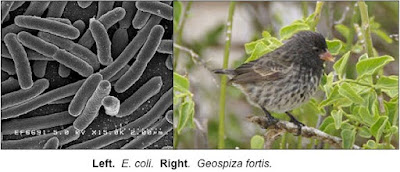
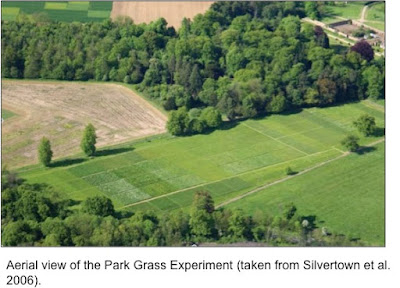
In 2002, Peter Grant and Rosemary Grant published a 30-year study that showed how the direction and magnitude of selection fluctuates wildly over the long term. Environmental change and infrequent hybridization led to a phenotypic trajectory in the Galapagos finches that was not predictable in the short term. Both Lenskis work and the Grants study, however pale in comparison to the Park Grass experiment started by John B. Lawes and Joseph H. Gilbert in 1856 at Rothamsted, Hertfordshire, England. This experiment is the longest running ecological experiment in the world and over 170 publications have come out of it. Although it was started to test how different fertilizers would improve yield, it has since inspired new ecological theory (resource ratio hypotheses), demonstrated long term population dynamics related to life history not detectable over a shorter time period, and provided examples of local adaptation, reproductive isolation and drift. More importantly what this experiment and the two other long-term studies show is that these types of experiments grow in value with time. Although conceived to investigate one scientific question, they can be used to answer a multitude of interesting and often unexplored areas.
The benefits of long term studies like this one seem obvious and yet it is no surprise that they are rare. In fact, in the book The Clock of the Long Now, Stewart Brand laments that science today “is more often driven at a commercial or even fashion velocity than at the deliberate pace of governance or the even slower pace of nature. “ He offers seven reasons for why more scientists are not performing this kind of research.
There are many short term studies that don’t use hypothesis driven research. We only need to look to the new discipline of bioinformatics to see examples of research that look for patterns in DNA sequence and expression data. Furthermore, I disagree with his last point. In such a computer advanced and internet driven society, the database and archival capacity of computers is enormous and the internet makes accessibility less of a problem. I think, that what explains why we don't see many long term experiments, is largely due to the structure and incentive model of granting agencies and academic institutions, specifically in North America.
Long-term experiments or studies require a scientist who is patient, thorough, and slow. The superstars in my field are anything but slow. Instead, as Brand states they tend to “track noisy signals too closely and confuse themselves by making changes before the effects of previous actions are clear.” In other words, publish one paper and then six months later publish another renouncing the results of the first. Why? Because that is how the game is played. The current game rewards prolific at the expense of being profound.
(Although I've heard the common refrain from faculty that some members of a search committee do look for quality, I wonder how many of them have actually read any of the papers from the job candidates. And if that assessment of quality is based on the journal's impact factor or the faculty member's own assessment of the candidate's science? It seems to me that there is a clear unwritten understanding that not every paper that gets into those high impact journals is actually profound and quality science. Here again the time factor creates an atmosphere of rush.)
Prolific is what gets you the chance at a t-t job, grants and ultimately the sweetest of all carrots - tenure. The system in the US (maybe less so in Canada) doesn’t support patient, thorough, slow, and profound science. Here in the US, despite being hired by colleagues, a good scientist can find themselves fired by these same people in 3-5 years when they go up for tenure. Fired or given terminal contracts simply because they didn't have the requisite number of publications or a lack of external funding. But really, how many are actually lucky enough to get funding when success rates at NIH and NSF are 7-12%. In Canada, this doesn’t happen. Once hired as an assistant professor, it’s rare that you don’t get tenure. The screening process for tenure is in the hiring, as my PhD supervisor once told me.
An environment that uses a carrot (tenure) and stick (terminal contract) incentive model narrows people’s focus and destroys creativity. If you don’t believe me, listen to the facts put forward by Daniel Pink, in his TED talk (it's worth 17 minutes of your time) on the science of motivation. Why would you spend time doing science that you think is worthwhile when it doesn’t get you the carrot. Instead, the choice is obvious, you do science that you know will work, ie get you the publications, the grants, all in the drive for tenure. This carrot and stick model leaves no room for innovation and creativity. In fact, TheDude, a tenured professor at a prestigious university told me, “Academia is broken. It's out of control. Getting tenure is the part that makes it broken.” He advises his students to do whatever it takes to get tenure and then “You can start doing the science you really think is worthwhile.” But I wonder what does that say about the science you do up until that point? And really by the time you do get tenure, if all your training is focused on routine, obvious, mechanical science, will you be practiced in innovative thinking such that you will even know which questions to ask?
A second effect that this “if you do this then you will get this or else” atmosphere does is it creates and attracts a particular type of scientist to academia and selects against another. One academic I know, has said that he doesn’t participate in a project unless he sees a publication in it for himself. Cutthroat, yes. But, at least honest. I can think of several colleagues of mine who are so much smarter than the known superstars in my field, both in terms of the quality of science and the level of innovation in their science. But they won’t make it. Why? Because they don’t want to publish just anything for the sake of publishing. And, they would argue, isn’t there enough shit to wade through already? Instead they want the work to matter. They would much rather have solid, well thought out, and fully explored ideas in 3 papers than 10 papers that either test the obvious, review a topic that has already been reviewed, or just do acceptable science. Again words from TheDude, “The problem is the number of papers that anyone individual produces is out of control. If I were the king I would eliminate half the journals especially N and S and limit people to publishing only two papers a year.”
My feeling is that somewhere between the two extremes is probably the right place. Half baked ideas are okay to publish as long as the author acknowledges the limitations and the caveats associated with their incompleteness. And we definitely need innovation and profound, thoughtful scientists. After all, diversity is the stuff of evolution. And progress is only achieved when there is diversity. So the real question is can academia in its current state support both types of scientists (fast and slow) and both types of studies (short and long term)? My belief is that it cannot in its current form. What will be the effect in the long term on the quality of academic science?
“We see nothing of these slow changes in progress, until the hand of time has marked the long lapse of ages.” Darwin (1859).
I guess we shall just have to wait to see the outcome of this long-term experiment.
Interested in reading some of the papers I cited? See below:
Barrick, J. E., D. S. Yu, S. H. Yoon, H. Jeong, T. K. Oh, D. Schneider, R. E. Lenski, and J. F. Kim. 2009. Genome evolution and adaptation in a long-term experiment with Escherichia coli. Nature 461:1243-1247.
Blount et al. (2008) Historical contingency and the evolution of a key innovation in an experimental population of Escheria coli. PNAS 105:7899-7906.
Brand, S. (1999) The Clock of the Long Now: time and responsibilities.
Carroll et al. (2007) Evolution on ecological time-scales. Functional Ecology 21: 387-393.
Grant, P.R. and Grant, R. (2002) Unpredictable evolution in a 30-year study of Darwin’s finches. Science 296: 707-711.
Conway Morris, S (2003) Life's Solution. Cambridge Uni Press, Cambridge, UK.
Silvertown et al. (2006) The Park Grass Experiment 1856-2006: its contribution to ecology. Journal of Ecology 94: 801-814.
Wichman, H.A., J. Millstein, and J.J. Bull. (2005) Adaptive molecular evolution for 13,000 phage generations: a possible arms race. Genetics 170:19-31.
This anecdote is my way of saying, that as academic scientists we make choices on a daily basis to pursue what is expedient at the cost of what may turn out to be interesting, all because of the lack of time. This rushed time frame creates an environment that does not support slow science. And it made me think back to my first post on Slow Science Gets The Shaft: Part 1. And the supposed follow-up that I said I would write and never did. Well folks, here it is. Part 2. Albeit, terribly, terribly slow (bad pun intended) to arrive. It’s a novel – so get yourself a cup of java and a healthy gluten free muffin and sit ‘er down.
In February the Lenski lab celebrated the 50,000 generation mark of their long term E.coli experiment. This experiment was started in Feb 1988 with a single genotype or clone (not a single microbial cell). From this single clone, 12 replicate populations were grown in 12 separate liquid environments (12 flasks with Davis Media broth supplemented with glucose and citrate). The lines are identical, except for a neutral marker that distinguishes six of the lines from the other six. Once in the flask, the populations are grown at 37°C for 24 hrs. After 24h, a subset of the population from each of the 12 flasks are transferred to a new flask with fresh media and the whole growth process is started anew. Furthermore every 75-500 generations (depends on which paper you read), samples are frozen down. These then provide a fossil record with which to ask what were the changes and how many occurred over time, etc. In 24h bacteria, divide approximately 6.67x, which means that Lenski and his students/postdocs have been doing this for every day for 7496.25 days or 20 years.
Lenski is a fantastic evolutionary biologist and a visionary. His experimental designs are awesome. He’s TheMan. If you look at the list of former students and postdocs that have come out of his lab, it reads like a Hollywood’s who’s who in evolutionary biology. I realize the term visionary might seem a little extreme to many, but it’s not. The reason is because Lenski had the foresight to recognize that what’s interesting and unpredictable is found, not in the short term, but often emerges from a long-term pattern. Although many organisms can undergo adaptive change in a relatively few generations and strong selection creates observable differences among populations within a species, it is only through the long-term changes that we can really understand what processes were relevant. As Conway Morris has said, “The possible evolutionary routes are many, but the destinations limited.” As a young academic, Lenski had to invest time and money to follow his curiousity about science, in a way that today’s young tenure track academics, limited by the drive to get tenure and funding, can’t do.
Did it pay off? Yes, of course. Work from these populations demonstrate parallel phenotypic evolution, changes in morphology relative to the ancestor, the evolution of increased DNA supercoiling with parallel changes in gene expression profiles, and the evolution of mutator phenotypes. But there are two major findings that came out only after the experiment was run for 20 years. First last fall, this paper came out in Nature. It showed that the rate of adaptation, as measured by the number of beneficial mutations accrued over time, exhibits a clock-like regularity. This clock-like behaviour is often expected from neutral evolution but not necessarily from adaptive change. Lenskiites were not the first to show this surprising result, Wichman and colleagues (2005), demonstrated a similar result with a bacteriophage growing in a chemostat for 13,000 generations. Whether macroevolution is nothing more than an aggregate of many small events, as Sean Carroll (2007) suggests is only explainable by experiments that quantify those events over the long term.
The second very cool result was that a key innovation happened in one of the replicate populations. Typically, under oxygen rich conditions, E.coli eats and metabolizes glucose (its carbon source), with no ability to use citrate as an energy source. Well guess what? In one of the replicate populations, a citrate-using genotype finally evolved at generation 31,500. That a key innovation evolved so late in the experiment, is telling about the importance of doing long-term studies.

In 2002, Peter Grant and Rosemary Grant published a 30-year study that showed how the direction and magnitude of selection fluctuates wildly over the long term. Environmental change and infrequent hybridization led to a phenotypic trajectory in the Galapagos finches that was not predictable in the short term. Both Lenskis work and the Grants study, however pale in comparison to the Park Grass experiment started by John B. Lawes and Joseph H. Gilbert in 1856 at Rothamsted, Hertfordshire, England. This experiment is the longest running ecological experiment in the world and over 170 publications have come out of it. Although it was started to test how different fertilizers would improve yield, it has since inspired new ecological theory (resource ratio hypotheses), demonstrated long term population dynamics related to life history not detectable over a shorter time period, and provided examples of local adaptation, reproductive isolation and drift. More importantly what this experiment and the two other long-term studies show is that these types of experiments grow in value with time. Although conceived to investigate one scientific question, they can be used to answer a multitude of interesting and often unexplored areas.
The benefits of long term studies like this one seem obvious and yet it is no surprise that they are rare. In fact, in the book The Clock of the Long Now, Stewart Brand laments that science today “is more often driven at a commercial or even fashion velocity than at the deliberate pace of governance or the even slower pace of nature. “ He offers seven reasons for why more scientists are not performing this kind of research.
1. Long term studies aren’t about proving or disproving hypotheses.
2. They don’t generate quick papers, the coin of science
3. They bear no relation to scientific fashion, where the excitement is
4. Not subject to money making patent or copyright.
5. They die when the primary researcher dies.
6. Extremely difficult to maintain funding
7. Archives are expensive and a hassle to service and keep accessible.
There are many short term studies that don’t use hypothesis driven research. We only need to look to the new discipline of bioinformatics to see examples of research that look for patterns in DNA sequence and expression data. Furthermore, I disagree with his last point. In such a computer advanced and internet driven society, the database and archival capacity of computers is enormous and the internet makes accessibility less of a problem. I think, that what explains why we don't see many long term experiments, is largely due to the structure and incentive model of granting agencies and academic institutions, specifically in North America.
Long-term experiments or studies require a scientist who is patient, thorough, and slow. The superstars in my field are anything but slow. Instead, as Brand states they tend to “track noisy signals too closely and confuse themselves by making changes before the effects of previous actions are clear.” In other words, publish one paper and then six months later publish another renouncing the results of the first. Why? Because that is how the game is played. The current game rewards prolific at the expense of being profound.
(Although I've heard the common refrain from faculty that some members of a search committee do look for quality, I wonder how many of them have actually read any of the papers from the job candidates. And if that assessment of quality is based on the journal's impact factor or the faculty member's own assessment of the candidate's science? It seems to me that there is a clear unwritten understanding that not every paper that gets into those high impact journals is actually profound and quality science. Here again the time factor creates an atmosphere of rush.)
Prolific is what gets you the chance at a t-t job, grants and ultimately the sweetest of all carrots - tenure. The system in the US (maybe less so in Canada) doesn’t support patient, thorough, slow, and profound science. Here in the US, despite being hired by colleagues, a good scientist can find themselves fired by these same people in 3-5 years when they go up for tenure. Fired or given terminal contracts simply because they didn't have the requisite number of publications or a lack of external funding. But really, how many are actually lucky enough to get funding when success rates at NIH and NSF are 7-12%. In Canada, this doesn’t happen. Once hired as an assistant professor, it’s rare that you don’t get tenure. The screening process for tenure is in the hiring, as my PhD supervisor once told me.
An environment that uses a carrot (tenure) and stick (terminal contract) incentive model narrows people’s focus and destroys creativity. If you don’t believe me, listen to the facts put forward by Daniel Pink, in his TED talk (it's worth 17 minutes of your time) on the science of motivation. Why would you spend time doing science that you think is worthwhile when it doesn’t get you the carrot. Instead, the choice is obvious, you do science that you know will work, ie get you the publications, the grants, all in the drive for tenure. This carrot and stick model leaves no room for innovation and creativity. In fact, TheDude, a tenured professor at a prestigious university told me, “Academia is broken. It's out of control. Getting tenure is the part that makes it broken.” He advises his students to do whatever it takes to get tenure and then “You can start doing the science you really think is worthwhile.” But I wonder what does that say about the science you do up until that point? And really by the time you do get tenure, if all your training is focused on routine, obvious, mechanical science, will you be practiced in innovative thinking such that you will even know which questions to ask?
A second effect that this “if you do this then you will get this or else” atmosphere does is it creates and attracts a particular type of scientist to academia and selects against another. One academic I know, has said that he doesn’t participate in a project unless he sees a publication in it for himself. Cutthroat, yes. But, at least honest. I can think of several colleagues of mine who are so much smarter than the known superstars in my field, both in terms of the quality of science and the level of innovation in their science. But they won’t make it. Why? Because they don’t want to publish just anything for the sake of publishing. And, they would argue, isn’t there enough shit to wade through already? Instead they want the work to matter. They would much rather have solid, well thought out, and fully explored ideas in 3 papers than 10 papers that either test the obvious, review a topic that has already been reviewed, or just do acceptable science. Again words from TheDude, “The problem is the number of papers that anyone individual produces is out of control. If I were the king I would eliminate half the journals especially N and S and limit people to publishing only two papers a year.”
My feeling is that somewhere between the two extremes is probably the right place. Half baked ideas are okay to publish as long as the author acknowledges the limitations and the caveats associated with their incompleteness. And we definitely need innovation and profound, thoughtful scientists. After all, diversity is the stuff of evolution. And progress is only achieved when there is diversity. So the real question is can academia in its current state support both types of scientists (fast and slow) and both types of studies (short and long term)? My belief is that it cannot in its current form. What will be the effect in the long term on the quality of academic science?
“We see nothing of these slow changes in progress, until the hand of time has marked the long lapse of ages.” Darwin (1859).
I guess we shall just have to wait to see the outcome of this long-term experiment.

Interested in reading some of the papers I cited? See below:
Barrick, J. E., D. S. Yu, S. H. Yoon, H. Jeong, T. K. Oh, D. Schneider, R. E. Lenski, and J. F. Kim. 2009. Genome evolution and adaptation in a long-term experiment with Escherichia coli. Nature 461:1243-1247.
Blount et al. (2008) Historical contingency and the evolution of a key innovation in an experimental population of Escheria coli. PNAS 105:7899-7906.
Brand, S. (1999) The Clock of the Long Now: time and responsibilities.
Carroll et al. (2007) Evolution on ecological time-scales. Functional Ecology 21: 387-393.
Grant, P.R. and Grant, R. (2002) Unpredictable evolution in a 30-year study of Darwin’s finches. Science 296: 707-711.
Conway Morris, S (2003) Life's Solution. Cambridge Uni Press, Cambridge, UK.
Silvertown et al. (2006) The Park Grass Experiment 1856-2006: its contribution to ecology. Journal of Ecology 94: 801-814.
Wichman, H.A., J. Millstein, and J.J. Bull. (2005) Adaptive molecular evolution for 13,000 phage generations: a possible arms race. Genetics 170:19-31.
April 1, 2010
The glass ceiling of academia.

A new report published by the American Association of University Women (AAUW), called “Why So Few”, does a good job summarizing the information known to date about the under-representation of women in science and math. The report is an in-depth study (134pages) that examines the cognitive attitudes and achievements of girls vs. boys in maths and sciences at the high school level. It also re-iterates that the unconscious gender biases and climate within universities still impede women’s participation and success in STEM areas. Although there is little that is new, it does actually offer a few solutions. And part of the value of the report comes because it is a reminder of how far we have to go in order to get gender parity in academia.
I've highlighted some facts that I think are relevant.
The report finds that the number of women who have earned bachelor degrees in biological and agricultural sciences has more than doubled. In 1966 25% of women earned B.Sc and that number is now ~60%. And if you look at the earned doctorates in the biological sciences, the numbers have quadrupled. In all fields women are doing better with the exception of computer science where in fact the numbers appear to be declining.

At first glance this looks great.
But as we all are aware, if women are earning more and more doctorates in the biological and other STEM sciences then where are they?
The reason this report really interested me, is because over my morning porridge, I’ve been collecting a little data of my own. Mostly just out of curiosity. I’ve been visiting the webpages of various biological departments in universities across Canada and the US to find out what proportion of faculty are women. But what I want to know specifically is if the proportion of female faculty is inversely proportional to the research income of a school or total graduate student population. Furthermore, I decided to see what proportion of postdocs were female. For this data, I didn’t count lecturers or emeritus professors so it makes it a conservative estimate. Because I’m still collecting the data, the sample sizes are pretty low (N_Canada=12, N_USA=10), I think the story emerges is one that is corroborated with the data from this recent report. Below is the result:

Where are we? Well, many of us are doing postdocs. On average, across North America ~42% of postdocs are women. The numbers are not really different between Canada and the US - 40% and 44% respectively. But the clear pattern that emerges is that there is a 50% attrition rate of women from the postdoctoral level.
In Canada and the US, female faculty representation in biology departments is atrocious. If you look at the black dots, on the graph above, it is clear that there are no significant differences between the proportion of women faculty members in a biology department at a Canadian (0.220± 0.012) or a US university (0.230±0.018).
Then I read a proclamation in the NYTimes about how “Women making gains on faculty at Harvard.”
Here is another excerpt from the article,
"University-wide, slightly more than a quarter of Harvard faculty members are women, an all-time high, with the senior faculty accounting for most of the increase. "
And according to my data, Harvard has a better female faculty representation than the national average with 27% of its biology faculty being female.
Later in the article,
“Different departments are at different points,” said Elena M. Kramer, a biology professor. “In biology, where women earn half the Ph.D.’s, it’s not so hard to hire women. You don’t need any hand-wringing; if you’re doing a good search, you’ll get women. ”
So if it's not so hard to hire women then why are only 23% of biology faculty across the United States and Canada women? And according to NSF stats in the last few years only 25-30% of new hires in the biological and life sciences were women .
Apparently, Why So Few re-iterates research suggesting that there is bias in peer review, evaluation, and hiring. Here is an excerpt from the report,
"Research has also pointed to bias in peer review (Wenneras & Wold, 1997) and hiring (Stein- preis et al., 1999; Trix & Psenka, 2003). For example, Wenneras and Wold found that a female postdoctoral applicant had to be significantly more productive than a male applicant to receive the same peer review score. This meant that she either had to publish at least three more papers in a prestigious science journal or an additional 20 papers in lesser-known specialty journals to be judged as productive as a male applicant. The authors concluded that the systematic underrating of female applicants could help explain the lower success rate of female scientists in achieving high academic rank compared with their male counterparts.
Trix and Psenka (2003) found systematic differences in letters of recommendation for academic faculty positions for female and male applicants. The researchers concluded that recommenders (the majority of whom were men) rely on accepted gender schema in which, for example, women are not expected to have significant accomplishments in a field like academic medicine. Letters written for women are more likely to refer to their compassion, teaching, and effort as opposed to their achievements, research, and ability, which are the characteristics highlighted for male applicants. While nothing is wrong with being compassionate, trying hard, and being a good teacher, arguably these traits are less valued than achievements, research, and ability for success in academic medicine. The authors concluded, “Recommenders unknowingly used selective categorization and perception, also known as stereotyping, in choosing what features to include in their profiles of the female applicants.”
Furthermore even when they do make it to t-t faculty positions, Why So Few suggests that women are less satisfied with the academic workplace and thus are more likely to leave it earlier in careers. Yet another excerpt,
"Women cited feelings of isolation, an unsupportive work environment, extreme work schedules, and unclear rules about advancement and success as major factors in their decision to leave. In a recent study on attrition among STEM faculty, Xu (2008) showed that female and male faculty leave at similar rates; however, women are more likely than men to consider changing jobs within academia. Women’s higher turnover intention in academia (which is the best predictor of actual turnover) is mainly due to dissatisfaction with departmental culture, advancement opportunities, faculty leadership, and research support."
So what solutions does this report offer? It suggests that departments conduct internal reviews to assess the climate for female faculty, cultivate an inclusive environment by providing an opportunity for all junior faculty to collaborate with senior faculty, providing accountable mentorship, and implement policies like stopping the tenure clock for parental leave that support a faculty work-life balance.
While all this is a step forward toward the retention of junior female faculty, it doesn't address a major issue. We are losing women at the transition stage from postdoctoral to faculty level. My preliminary data support this. As far as I could tell the only suggestion the report makes is to raise awareness of implicit biases.
You know, I'm pretty tired of people saying that raising awareness is the solution. Frankly, all it does is make people pissed off that they have to waste time in some politically correct workshop to make them a better human being. I think of one particular faculty member I know that could benefit from this. But he would scoff at the idea that he holds any biases against women. Yet it is clear to all, both in terms of his language and actions, that he does in fact believe that women can't do science on their own. And even if these workshops were mandatory, the very people who obviously need it will find a way out.
One idea that might help recruit female postdocs into faculty level jobs is getting women postdocs into an active mentorship program. I don't mean the kind where you meet once a week for a cafe. There's a place for that, but I mean active participation in hiring committees, grant review committees, etc. From what I hear, some grant review panels at NSF have started to include a postdoc. This is a great idea. it will make the system less oblique and offer a postdoc a view into what makes a successful grant and what doesn't before jumping into the snake pit.
It's a step. A small one.
I could think of a more drastic way to break the glass ceiling in academia. For the next five years make the majority of the hires in biology departments - women. I think that is what it will take.
And I know many of you are thinking "yes, but that's reverse discrimination." Yes, yes it is. And not that I advocate this, but imagine a scenario where we’ve achieved this marvelous state of gender parity in terms of representation, do you think that the workplace will remain dissatisfying?
Think again.
Change comes from demand. As it stands, there is no demand for change because women only make up a small proportion of the workplace. This kind of change will not only make things better for women but also for men.
But you know what? It's only a dream and the small steps that are occurring are not going to happen to make a difference in my academic career. Given the latest reports of economic gloom and the contraction of universities such that departments across the US closing and laying off tenured professors, I doubt that women will make many gains. Economic hardship tends to make people conservative in their choices. This means that glass ceiling is probably going to get thicker.
So as I sit here with my tea and porridge and calculate my probability of getting a tenure-track position given that I'm a woman and there is an economic depression. And I couple this with the possibility that to even get that t-t position it may take oh another 3-5 years of postdocing. And let's say I actually get that t-t position, but when the time comes for me to go up for tenure after 3-5 years because I can't secure funding (i.e. 7-12% success rates at NIH), I end up with my ass on the curb. That's 6-10 years before I am looking at the very narrow possibility of a tenured professorship at a university.
If I were 21 years old it might not matter. But like many in my cohort, I'm not. I understand that I'm important as a role model and that I should carry on to be present in the system.
But at what personal cost?
Frankly, alternative career paths are starting to look more and more attractive.
March 18, 2010
How do you make the switch to industry?
My last post elicited two very interesting comments and I am really glad that Miko and Anonymous added their thoughts. It made me wonder about how one makes that transition into industry. I would be really interested in those of you who are currently in industry telling the story of how you made the transition.
In particular I'd want to know:
Without giving too much away, what type of work do you currently do, i.e pharma, energy, or agricultural etc? Do you work for a big or small company?
Why did you make the switch from academia to industry? What were your motivations?
Did you have a good experience in your PhD or was it difficult? Was your PhD related to applied research that the transition seemed natural or was it in a basic science?
What was difficult about this transition and what was easy?
How did you make the transition? Did you know someone at the company or did you just send out your resume to job postings?
I think many of us would benefit from these stories. So if you are currently in an non-academic position and want to write a guest post detailing your journey from academia into industry, please contact me at girlpostdoc@gmail.com or just leave a comment in the comment section.
In particular I'd want to know:
Without giving too much away, what type of work do you currently do, i.e pharma, energy, or agricultural etc? Do you work for a big or small company?
Why did you make the switch from academia to industry? What were your motivations?
Did you have a good experience in your PhD or was it difficult? Was your PhD related to applied research that the transition seemed natural or was it in a basic science?
What was difficult about this transition and what was easy?
How did you make the transition? Did you know someone at the company or did you just send out your resume to job postings?
I think many of us would benefit from these stories. So if you are currently in an non-academic position and want to write a guest post detailing your journey from academia into industry, please contact me at girlpostdoc@gmail.com or just leave a comment in the comment section.
March 1, 2010
Dissent gets a fat lip.
About 5 years ago I walked across northern Spain from Somport, France to Santiago, Spain on a trek that is called the Camino el Norte. There, I experienced what I had the hoped would be also possible in the bloggosphere. On the camino, you knew people's names, a little bit about why they were walking, but mainly what you knew of them was their direct experiences walking on the camino. There was never any discussion about what they did. And whenever anyone tried to ask - so what do you do? The answer was always the same. I walk on the camino.
So I had naively thought that the bloggosphere would be like the camino. Thinking that 'the bloggosphere' would be a place without prejudice and that the hierarchy which existed in the real academic world would somehow be absent in this virtual one. In my ideal, the virtual world was a more level playing field where an individual's position (PhD student, postdoc, faculty) was irrelevant and all that mattered was that you walked in the academic world.
Much discussion has been written about young female scientist (YFS) and her experience. I use the word “about” because in these discussions, often taking place in the comments section of another’s blog, her actual voice is absent. I recognize that YFS cannot always present but the representation of her experience is noticeably absent.
Second, I have also noticed that during this discussion a number of disparging remarks are written largely (but not always) by faculty bloggers. Usually it comes in this form,
This kind of comment invalidates young female scientist’s direct experience of the academic camino. It does so because it inverts the power dynamic inherent in the academic hierarchy by suggesting that the individual is to blame for their current circumstance. In a fair and just system, based on a meritocracy, each person receives an equitable lot. That the system is fair and just is implicitly assumed by the commentator. By asserting that young female scientist is speaking on behalf of all postdocs, the commentator deflects any consideration away from what aspects of the system led to this experience. Lastly, the author suggests that there is a generalized experience of the academic camino, but that this is not it.
The concern that this one voice, identified as “marginal” will become the authority of the postdoctoral experience, is expressed repeatedly both in comments and in blog posts on the topic. In protecting the clear and distinct rules of the road, much effort is expended to ensure that this experience is seen as a singular experience.
Here, the author emphasizes the “otherness” of young female scientist’s experience. Although prefacing the comments by suggesting that s/he doesn't want to forget what the postdoc experience can be, the author immediately uses language to describe MsPhD and company's posts as "extreme ranting" and comments that "skirts the far edges of the distribution." Because these experiences originate from what is a decidedly emotional space, they are deemed not real or valid. Lastly, the author of this comment revokes any validity to YFS's voice by suggesting that if YFS just changed her filter she might have a different experience. Hers is a perceived injustice not a real one.
Finally let’s look at a more recent exchange at PLT’s blog between largely faculty bloggers:
Again I draw attention to the quality of the language used by the commentators. It is paternalistic and condescending. The commentators employ a language that reminds postdocs or “children” that they can only participate in the academic camino because they, the faculty/parents allow it. But in the above exchange, postdocs are clearly told that they are not equals and that they will not be treated as equals even though a “senior” postdoc may be days or months away from being in a tenure track position.
These types of verbal exchanges, described above, use language in a way that sets the faculty blogger in the role where they decide what experiences are authentic and what should be dismissed as merely “emotional.” As was the case with black women during much of the feminist movement, if black women dared to criticize the white feminist movement, their voices were tuned out, dismissed, and silenced. Only those whose experiences echoed the sentiments of the dominant discourse were heard (Bell Hooks From Margin to Center).
Language has the power to inspire and motivate us, as Haig Bosmajian suggests in his essays The Language of Oppression, but it can also be used to justify and maintain a hierarchy by taking possession of experience.
Academia is an institutionalized hierarchy and as such it has the potential to create a very real and lived experience of oppression. Embedded in this hierarchy is privilege and class. Chairs or Directors of Departments have power over faculty. Faculty have power over postdocs, graduate students, and undergrads. Postdocs have power over undergrads and sometimes grad students. Grad students have power over undergrads. At some level, each of us that walk along the academic road carry the weight of that privilege.
How do we ensure that dissenting voices are not ghettoized and ruthlessly critiqued? It is too easy to use language that is less than mindful because it ensures “blog traffic.” I have, in the past, hidden behind pseudoanonymity assuming that it gives me the freedom to say and write what I want. And I think many bloggers view the bloggosphere as “outside the constraints of the scientific and academic writing.”
But is it really?
Our everyday reality is informed and shaped by politics and is therefore necessarily political. Even my choices to identify myself with specific labels: girl, postdoc, Canadian, are political. I write to and about my personal experience because I believe it should be given voice. But in writing about my personal experience, should I dismiss or marginalize others? If, we cease to focus on the simplistic stance that “faculty are the enemy” or “postdocs are children,” then we have an opportunity to examine our role in the maintenance of oppressive social circumstances. A broader understanding of how our personal actions can affect the political sphere of another’s life cannot arise if those whose experiences are different are simply quieted.
The totality of the academic road includes all experiences – good and bad.
And to get to that place of a broader under-standing, it requires that we are “standing under” or “in” someone’s experience for long enough that this person’s experience penetrates and dissolves our judgements.
So I had naively thought that the bloggosphere would be like the camino. Thinking that 'the bloggosphere' would be a place without prejudice and that the hierarchy which existed in the real academic world would somehow be absent in this virtual one. In my ideal, the virtual world was a more level playing field where an individual's position (PhD student, postdoc, faculty) was irrelevant and all that mattered was that you walked in the academic world.
Much discussion has been written about young female scientist (YFS) and her experience. I use the word “about” because in these discussions, often taking place in the comments section of another’s blog, her actual voice is absent. I recognize that YFS cannot always present but the representation of her experience is noticeably absent.
Second, I have also noticed that during this discussion a number of disparging remarks are written largely (but not always) by faculty bloggers. Usually it comes in this form,
Once again, you're blaming "the system" for your shitty situation. You're also generalizing, again, that your situation automatically means that all postdoc experiences completely suck and that those people who move on to faculty positions did so at your expense.
This kind of comment invalidates young female scientist’s direct experience of the academic camino. It does so because it inverts the power dynamic inherent in the academic hierarchy by suggesting that the individual is to blame for their current circumstance. In a fair and just system, based on a meritocracy, each person receives an equitable lot. That the system is fair and just is implicitly assumed by the commentator. By asserting that young female scientist is speaking on behalf of all postdocs, the commentator deflects any consideration away from what aspects of the system led to this experience. Lastly, the author suggests that there is a generalized experience of the academic camino, but that this is not it.
The concern that this one voice, identified as “marginal” will become the authority of the postdoctoral experience, is expressed repeatedly both in comments and in blog posts on the topic. In protecting the clear and distinct rules of the road, much effort is expended to ensure that this experience is seen as a singular experience.
"I too worry about forgetting what it was like. That's why I read MsPHD and company. It is a reminder, even if some of it skirts the far edges of the distribution. Personally I am helped in my reading of MsPHD's more extreme ranting because I do in fact know a lab quite well that could produce a situation much as she perceives it.”
Here, the author emphasizes the “otherness” of young female scientist’s experience. Although prefacing the comments by suggesting that s/he doesn't want to forget what the postdoc experience can be, the author immediately uses language to describe MsPhD and company's posts as "extreme ranting" and comments that "skirts the far edges of the distribution." Because these experiences originate from what is a decidedly emotional space, they are deemed not real or valid. Lastly, the author of this comment revokes any validity to YFS's voice by suggesting that if YFS just changed her filter she might have a different experience. Hers is a perceived injustice not a real one.
Finally let’s look at a more recent exchange at PLT’s blog between largely faculty bloggers:
“Ooooooh boy.... Here comes the rain.
Whatever you do, don't mention the tattoos.
Well, the fact that the commenter believes that TT faculty suddenly develop amnesia about their postdoc experiences the moment they become Asst. Profs suggests that nothing any TT faculty member says will make any difference to her. This is fundamentally not a position that can be reasoned with.
From what I've observed, it seems to me that the relationship between a senior postdoc and her advisor is similar in some ways to that between a 17-year-old ready to get the hell out of her parents' house and the parents. Perhaps it takes becoming a parent to see things from the other side.
...exactly. Great analogy!
…makes the point that postdocs need to work within the system too, and I couldn't agree more.
It's been known for a long time the system was in trouble (COSEPUP, 2000). But it takes a long time and lot of effort to make changes.
happy or sad, all postdocs (and ex-postdocs!) should have the druthers to work the NPA, their local Postdoc Office, call your local reps. DO SOMETHING instead of just moaning.
Sack up or get out (of science or your shitty lab). Either way stop wasting your life- there's fuck all of it and it doesn't come with a recharge cord.”
Again I draw attention to the quality of the language used by the commentators. It is paternalistic and condescending. The commentators employ a language that reminds postdocs or “children” that they can only participate in the academic camino because they, the faculty/parents allow it. But in the above exchange, postdocs are clearly told that they are not equals and that they will not be treated as equals even though a “senior” postdoc may be days or months away from being in a tenure track position.
These types of verbal exchanges, described above, use language in a way that sets the faculty blogger in the role where they decide what experiences are authentic and what should be dismissed as merely “emotional.” As was the case with black women during much of the feminist movement, if black women dared to criticize the white feminist movement, their voices were tuned out, dismissed, and silenced. Only those whose experiences echoed the sentiments of the dominant discourse were heard (Bell Hooks From Margin to Center).
Language has the power to inspire and motivate us, as Haig Bosmajian suggests in his essays The Language of Oppression, but it can also be used to justify and maintain a hierarchy by taking possession of experience.
Academia is an institutionalized hierarchy and as such it has the potential to create a very real and lived experience of oppression. Embedded in this hierarchy is privilege and class. Chairs or Directors of Departments have power over faculty. Faculty have power over postdocs, graduate students, and undergrads. Postdocs have power over undergrads and sometimes grad students. Grad students have power over undergrads. At some level, each of us that walk along the academic road carry the weight of that privilege.
How do we ensure that dissenting voices are not ghettoized and ruthlessly critiqued? It is too easy to use language that is less than mindful because it ensures “blog traffic.” I have, in the past, hidden behind pseudoanonymity assuming that it gives me the freedom to say and write what I want. And I think many bloggers view the bloggosphere as “outside the constraints of the scientific and academic writing.”
But is it really?
Our everyday reality is informed and shaped by politics and is therefore necessarily political. Even my choices to identify myself with specific labels: girl, postdoc, Canadian, are political. I write to and about my personal experience because I believe it should be given voice. But in writing about my personal experience, should I dismiss or marginalize others? If, we cease to focus on the simplistic stance that “faculty are the enemy” or “postdocs are children,” then we have an opportunity to examine our role in the maintenance of oppressive social circumstances. A broader understanding of how our personal actions can affect the political sphere of another’s life cannot arise if those whose experiences are different are simply quieted.
The totality of the academic road includes all experiences – good and bad.
And to get to that place of a broader under-standing, it requires that we are “standing under” or “in” someone’s experience for long enough that this person’s experience penetrates and dissolves our judgements.
Before you know what kindness really is
you must lose things, feel the future dissolve in a moment
like salt in a weakened broth.
What you held in your hand,
what you counted and carefully saved,
all this must go so you know
how desolate the landscape can be
between the regions of kindness.
Before you learn the tender gravity of kindness,
you must travel where the
Indian in a white poncho lies dead
by the side of the road.
You must see how this could be you, how he too was someone who journeyed through the night
with plans and the simple breath
that kept him alive.
Before you know kindness
as the deepest thing inside,
you must know sorrow
as the other deepest thing.
You must wake up with sorrow.
You must speak to it till your voice
catches the thread of all sorrows
and you see the size of the cloth.
Then it is only kindness
that makes sense anymore,
only kindness that ties your shoes
and sends you out into the day
to mail letters and purchase bread,
only kindness that raises its head
from the crowd of the world to say
it is I you have been looking for,
and then goes with you every where
like a shadow or a friend. Naomi Shihab Nye
December 27, 2009
Why small universities need to step up.
Today, I awoke from a dream feeling like I had been hit by a U-haul truck. In the dream, I was trying to take a hot bubble bath - one of my favourite ways to relax. But I couldn't even get into the water because floating at the surface were a ton of 10 uL pipette tips as if someone had taken one of those filter-tip boxes and just dumped it into the bathtub . Before I could get in, I had to fish each one individually out of the tub. Then, just as I had fished out the last of the pipette tips and was about to get in, I was interrupted by a banging at the door. I opened the door to see one of my old boyfriends standing, as always, like a peacock who thinks his tail is more magnificent than it really is. He looked awful (small mercies). The last time I saw this guy - he was pretty fit but now looking at him his face was all pudgy and red surrounded by this black, curly, ear-length hair. He didn't say anything then just disappeared. I closed the door and was met with yet another interruption. Needless to say I never got to relax.
This was one of the more straightforward dreams I have ever had and I'm totally aware that it is a metaphor for my current life. Normally my dreams are vivid and suspense-filled movies where I am chasing or being chased, searching for lost treasure, zipping in and through time, taking part in some major espionage, living in a concentration camp, the list goes on. Once, I was a big, black, male jazz singer and HippieHusband awoke to me shouting in a gravelly voice, "Bourbon, oh yeah bourbon." Geez, I've never tasted bourbon before in my life.
It's only when I'm truly stressed by the everyday that I have the tedious and highly mundane dreams. When I was in the deepest and darkest part of the Ph.D. thesis, I had a dream in which I stepped into a graphical representation of my data to examine each and every datapoint. Yawn!
Well, I think that HippieHusband's current work situation is interfering with my ability to relax and enjoy the holidays. It's funny because everyone that we spoke to in BigCity Canada about the situation all responded with the same answer, "You can't stay there." This statement got me thinking a lot about how hard it will be for this SmallUniversity or any small university to attract and keep smart, independent, hard-working, and productive post-docs.
If the supervisor within a small university can't offer a working environment that is fun, stimulating, and most of all respectful (quitting a collaboration and firing your post-doc from the lab is just not respectful), then really why would anyone in their right mind stay?
What exactly does SmallUniversity in SmallTown America have to offer? There is little intellectual stimulation from within department because a) there are few journal clubs of note, b) the labs are small c) few invited seminars by cutting edge colleagues, and d) even fewer post-docs outside your lab. Outside the university environment, in the SmallTown there isn't a whole lot to do. Unlike BigCity, if all hell breaks out with your supervisor at SmallUniversity in SmallTown, you can't retreat to that yoga class, or go to that alternative cinema, or find theatre to attend, or de-stress at a concert, or go and take an art class at the art school, or eat wonderful food at great restaurants, or just hang out with friends in really cool places.
If you work at BigUniversity in BigCity, then as a supervisor you can be an asshole to your postdoc and probably get away with it. Why? The post-doc will probably stay because if you are a supervisor are at a BigUniversity then you are probably hot shit and can offer that post-doc something more - I call it the "by association." Plus the post-doc has colleagues and resources outside the lab that allow for intellectual stimulation. And finally, they get to live in BigCity X with all of its cultural activities and a myriad of restaurants.
So I believe the SmallUniversity tenured faculty have to STEP-UP when they learn that a post-doc is being mistreated and bullied. They need to advocate for their postdocs. And yes, I purposefully say "their" post-docs. Even though the post-doc is not directly in their lab, the presence of this post-doc contributes to the overall intellectual attractiveness of the university - making it a place that new Ph.D students might want to go. They can provide knowledge and advise to Ph.D. students not just in their own lab but to those students in the department. They are potential collaborators and colleagues. They are the ones to start those journal clubs that enrich the intellectual life of the school. The postdoc carries the weight and expertise of a faculty member in small labs where there are no lab technicians. And ultimately, they produce the papers that allow the faculty in the department to look good and get grants.
So if you think that the biggest attraction to the department offers a work-life balance or how inter-disciplinary collaborations at the university make it an exciting place to work - think again.
People don't quit environments they quit their bosses.
This was one of the more straightforward dreams I have ever had and I'm totally aware that it is a metaphor for my current life. Normally my dreams are vivid and suspense-filled movies where I am chasing or being chased, searching for lost treasure, zipping in and through time, taking part in some major espionage, living in a concentration camp, the list goes on. Once, I was a big, black, male jazz singer and HippieHusband awoke to me shouting in a gravelly voice, "Bourbon, oh yeah bourbon." Geez, I've never tasted bourbon before in my life.
It's only when I'm truly stressed by the everyday that I have the tedious and highly mundane dreams. When I was in the deepest and darkest part of the Ph.D. thesis, I had a dream in which I stepped into a graphical representation of my data to examine each and every datapoint. Yawn!
Well, I think that HippieHusband's current work situation is interfering with my ability to relax and enjoy the holidays. It's funny because everyone that we spoke to in BigCity Canada about the situation all responded with the same answer, "You can't stay there." This statement got me thinking a lot about how hard it will be for this SmallUniversity or any small university to attract and keep smart, independent, hard-working, and productive post-docs.
If the supervisor within a small university can't offer a working environment that is fun, stimulating, and most of all respectful (quitting a collaboration and firing your post-doc from the lab is just not respectful), then really why would anyone in their right mind stay?
What exactly does SmallUniversity in SmallTown America have to offer? There is little intellectual stimulation from within department because a) there are few journal clubs of note, b) the labs are small c) few invited seminars by cutting edge colleagues, and d) even fewer post-docs outside your lab. Outside the university environment, in the SmallTown there isn't a whole lot to do. Unlike BigCity, if all hell breaks out with your supervisor at SmallUniversity in SmallTown, you can't retreat to that yoga class, or go to that alternative cinema, or find theatre to attend, or de-stress at a concert, or go and take an art class at the art school, or eat wonderful food at great restaurants, or just hang out with friends in really cool places.
If you work at BigUniversity in BigCity, then as a supervisor you can be an asshole to your postdoc and probably get away with it. Why? The post-doc will probably stay because if you are a supervisor are at a BigUniversity then you are probably hot shit and can offer that post-doc something more - I call it the "by association." Plus the post-doc has colleagues and resources outside the lab that allow for intellectual stimulation. And finally, they get to live in BigCity X with all of its cultural activities and a myriad of restaurants.
So I believe the SmallUniversity tenured faculty have to STEP-UP when they learn that a post-doc is being mistreated and bullied. They need to advocate for their postdocs. And yes, I purposefully say "their" post-docs. Even though the post-doc is not directly in their lab, the presence of this post-doc contributes to the overall intellectual attractiveness of the university - making it a place that new Ph.D students might want to go. They can provide knowledge and advise to Ph.D. students not just in their own lab but to those students in the department. They are potential collaborators and colleagues. They are the ones to start those journal clubs that enrich the intellectual life of the school. The postdoc carries the weight and expertise of a faculty member in small labs where there are no lab technicians. And ultimately, they produce the papers that allow the faculty in the department to look good and get grants.
So if you think that the biggest attraction to the department offers a work-life balance or how inter-disciplinary collaborations at the university make it an exciting place to work - think again.
People don't quit environments they quit their bosses.
December 1, 2009
When the workplace betrays you...
Okay, let's say you had a friend who came to you for advice about his workplace. Here is a brief scenario:
There is a powerful man who has a great deal of influence at work. This is because he is in charge of a lot of money. But TheBully shits on most of his colleagues, who for some reason just accept this as his "personal style."
Your friend was not hired by TheBully, but by another person who directly supervises him. He simply borrows space in the TheBully's factory because the supervisor has a different kind of factory. And so, there are weekly meetings with his direct supervisor and TheBully.
In these meetings, however, TheBully verbally beats up on your friend.
Meeting One: TheBully, calls your friend, "Not passionate enough."
Meeting Two: TheBully claims, your friend is not working hard enough or fast enough, that TheBully will have to find someone else to replace your friend.
Meeting Three: TheBully tells your friend that he has two strikes against him. That he is not meeting expectations.
Now you know this friend quite well and you know that he works really hard. You know, for example, that your friend spend a month of unpaid work to learn the job from a previous factory worker who was leaving. That he didn't take a Christmas holiday so that he could replace the raw materials in a production line. Finally, in the course of literally one year, your friend has managed to get enough raw materials to produce two finished goods. By way of comparison, the person previously employed by TheBully for six years produced raw materials of very poor quality and thus no finished goods. Not only that, TheBully's factory has not produced any goods of high quality in the last 5 years. Needless to say, your friend's real supervisor has been quite happy with your friend's job performance so really it isn't a question of productivity.
Finally, Meeting Four: TheBully shouts questions at your friend about the raw materials. Remaining calm, your friend tries to answer the questions. But this was a 'question and answer game', where your friend answered, "Yes" and the bully would say "Wrong, it's no." Similarly if your friend said, "No" the bully yells, "Wrong, it's yes." After angrily spitting false accusations at your friend about stealing company materials, TheBully screams at your friend calling him arrogant. Several times, the supervisor tried to intervene but TheBully shut him down too. Then, TheBully stormed out of the room several times, and when he finally came back, asked your friend to get his raw materials out of his factory. Furthermore, TheBully ended the relationship not just with your friend but with his supervisor, saying he didn't care what the hell they did.
The next day, worried about some of the raw materials still in production in the TheBully's factory, the supervisor approaches TheBully. He tries to ask him what to do about the raw materials and to address the angry words in the previous meeting.
TheBully denies ever asking your friend to get his raw materials out of his factory. He denies it all.
What advice would you give your friend about this workplace situation?
There is a powerful man who has a great deal of influence at work. This is because he is in charge of a lot of money. But TheBully shits on most of his colleagues, who for some reason just accept this as his "personal style."
Your friend was not hired by TheBully, but by another person who directly supervises him. He simply borrows space in the TheBully's factory because the supervisor has a different kind of factory. And so, there are weekly meetings with his direct supervisor and TheBully.
In these meetings, however, TheBully verbally beats up on your friend.
Meeting One: TheBully, calls your friend, "Not passionate enough."
Meeting Two: TheBully claims, your friend is not working hard enough or fast enough, that TheBully will have to find someone else to replace your friend.
Meeting Three: TheBully tells your friend that he has two strikes against him. That he is not meeting expectations.
Now you know this friend quite well and you know that he works really hard. You know, for example, that your friend spend a month of unpaid work to learn the job from a previous factory worker who was leaving. That he didn't take a Christmas holiday so that he could replace the raw materials in a production line. Finally, in the course of literally one year, your friend has managed to get enough raw materials to produce two finished goods. By way of comparison, the person previously employed by TheBully for six years produced raw materials of very poor quality and thus no finished goods. Not only that, TheBully's factory has not produced any goods of high quality in the last 5 years. Needless to say, your friend's real supervisor has been quite happy with your friend's job performance so really it isn't a question of productivity.
Finally, Meeting Four: TheBully shouts questions at your friend about the raw materials. Remaining calm, your friend tries to answer the questions. But this was a 'question and answer game', where your friend answered, "Yes" and the bully would say "Wrong, it's no." Similarly if your friend said, "No" the bully yells, "Wrong, it's yes." After angrily spitting false accusations at your friend about stealing company materials, TheBully screams at your friend calling him arrogant. Several times, the supervisor tried to intervene but TheBully shut him down too. Then, TheBully stormed out of the room several times, and when he finally came back, asked your friend to get his raw materials out of his factory. Furthermore, TheBully ended the relationship not just with your friend but with his supervisor, saying he didn't care what the hell they did.
The next day, worried about some of the raw materials still in production in the TheBully's factory, the supervisor approaches TheBully. He tries to ask him what to do about the raw materials and to address the angry words in the previous meeting.
TheBully denies ever asking your friend to get his raw materials out of his factory. He denies it all.
What advice would you give your friend about this workplace situation?
May 26, 2009
Slow Science gets the Shaft - Part I
This blog post will be the first of a three-part series on my ideas of slow science.
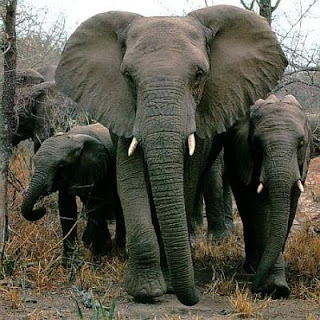 Today, we had a seminar presentation by an "old school" scientist who told us some amazing stories about a group of organisms that he had worked on since the 1950s. It wasn't a slick powerpoint talk with fancy slides, a simple one with pictures of the different representative species. With each picture he told us about key innovations in the group, what these things eat, their ecology, morphological differences, predatory behaviour - in other words basic biology.
OldSchool is a naturalist. He doesn't make fancy models, nor do sophisticated statistics on his data. But he knows everything about the group that he works on because he has been accumulating data slowly and over the long-term. Fifty years is a heck of a long time! Instead of chasing the "sexy" and "cutting edge" questions that happen to be the hot items that year, he's a "sit and wait" scientist that lets the interesting questions arise from what he observes and experiences with these organisms in their own habitats.
OldSchool does slow science and I think that this breed of scientist is going extinct to be replace by Fast'nFurious scientists; all of whom clamber over each other to get papers in Science and Nature. Crabs in a bucket. Frankly, given the rewards, ie a scientific career that is seen as set for life, why wouldn't they?
Often to get those high impact papers, I think many choose to work on model organisms because of the cost-benefit ratio. Given the nature of the academic treadmill, we don't have the luxury of spending time with a system to acquire basic natural history questions because that takes too long. And if you choose that road in my field, it can often mean fewer publications and papers with "less impact." Ultimately leading to fewer job opportunities and less funding. And universities value scientists directly in proportion to how much money they bring in, i.e. $$$=good little scientist.
And really I am as much a party to this game as anyone. Although, I worked on an organism during my PhD, whose first name was Large and whose last name was Slow, when given the choice to work on a similar sort of organism or switch and work with a small fast one, I opted to work on a small and fast one for my postdoc. (The humour in how the size of my study species mirrors the school I'm at, is not lost on me. LargeandSlow at LargeUniversityInCanada and SmallandFast at SmallUniversity in SmallTown America.)
Well, honestly I thought - a fast and small organism will result in more publications.
I think if OldSchool were to apply for a job now (with the same qualifications he had when he started), I don't think his application would even see the light of day. And, in my opinion, that would be a huge loss to science.
The seminar today made me wonder if our focus on fast science will impact our understanding of the natural world. By fast science, I mean a few different things: what we study, how we set up experiments and for how long we run them. The focus of this blogpost will be on what we study.
Much of the work in my field has been conducted on species that are small and fast: Drosophila, annual plants, viruses, etc. These species are easily amenable to field, greenhouse and/or laboratory research. And because they have short generation times, experiments can be conducted in a timely manner (i.e., completed within the timeframe of a Masters or Ph.D). This is not to say that people don't attempt to work on LargeandSlow species, but there is a lag in the payback.
Okay so before I go all postal on the fast organism I need to demonstrate if there really a bias in what we know. Do we have equal information on organisms with vastly different generation times?
I did a quick little survey, nothing I would ever stake my scientific career on, but it yielded some interesting things. In the Wiley InterScience Life Science Search page, I did three types of word searches. The first was simply finding the total number of articles published in Wiley journals for a given organism (eg "bacteria", "Drosophila").
The graph below shows what I think we all know is obvious. Of the total number of articles written, most of our knowledge is on the following organisms: mouse, fish, and bacteria. Not surprising really that we have a strong bias toward biomedical and applied research.
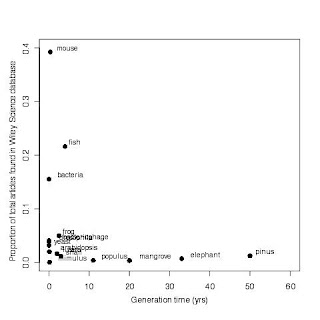 But in my second search instead of just typing in the name of the organism, I used the following keywords: “bacteria and ecology”, “bacteria and evolution. ” The results were much the same. The rank order was different (fish, mouse, bacteriophage, bacteria), but the shape of the curve suggests that even in ecology and evolution, research is focused on model organisms with a short generation times. There are 136X more articles on virus ecology and evolution, than there are about a deciduous tree.
As part of the MTV generation, I understand the desire for immediate gratification. This need for immediate results and productivity is heightened under our current climate of publish or perish without any money in an unmarked grave.
But I think something is lost when what we know of the natural world is observed using a lens that is made up of organisms with “easy” life cycles.
As Charles Darwin said, “...it is always advisable to perceive clearly our ignorance.”
“False facts are highly injurious to the progress of science, for they often endure long; but false views, if supported by some evidence, do little harm, for every one takes a salutary pleasure in proving their falseness.” Charles Darwin
 Today, we had a seminar presentation by an "old school" scientist who told us some amazing stories about a group of organisms that he had worked on since the 1950s. It wasn't a slick powerpoint talk with fancy slides, a simple one with pictures of the different representative species. With each picture he told us about key innovations in the group, what these things eat, their ecology, morphological differences, predatory behaviour - in other words basic biology.
OldSchool is a naturalist. He doesn't make fancy models, nor do sophisticated statistics on his data. But he knows everything about the group that he works on because he has been accumulating data slowly and over the long-term. Fifty years is a heck of a long time! Instead of chasing the "sexy" and "cutting edge" questions that happen to be the hot items that year, he's a "sit and wait" scientist that lets the interesting questions arise from what he observes and experiences with these organisms in their own habitats.
OldSchool does slow science and I think that this breed of scientist is going extinct to be replace by Fast'nFurious scientists; all of whom clamber over each other to get papers in Science and Nature. Crabs in a bucket. Frankly, given the rewards, ie a scientific career that is seen as set for life, why wouldn't they?
Often to get those high impact papers, I think many choose to work on model organisms because of the cost-benefit ratio. Given the nature of the academic treadmill, we don't have the luxury of spending time with a system to acquire basic natural history questions because that takes too long. And if you choose that road in my field, it can often mean fewer publications and papers with "less impact." Ultimately leading to fewer job opportunities and less funding. And universities value scientists directly in proportion to how much money they bring in, i.e. $$$=good little scientist.
And really I am as much a party to this game as anyone. Although, I worked on an organism during my PhD, whose first name was Large and whose last name was Slow, when given the choice to work on a similar sort of organism or switch and work with a small fast one, I opted to work on a small and fast one for my postdoc. (The humour in how the size of my study species mirrors the school I'm at, is not lost on me. LargeandSlow at LargeUniversityInCanada and SmallandFast at SmallUniversity in SmallTown America.)
Well, honestly I thought - a fast and small organism will result in more publications.
I think if OldSchool were to apply for a job now (with the same qualifications he had when he started), I don't think his application would even see the light of day. And, in my opinion, that would be a huge loss to science.
The seminar today made me wonder if our focus on fast science will impact our understanding of the natural world. By fast science, I mean a few different things: what we study, how we set up experiments and for how long we run them. The focus of this blogpost will be on what we study.
Much of the work in my field has been conducted on species that are small and fast: Drosophila, annual plants, viruses, etc. These species are easily amenable to field, greenhouse and/or laboratory research. And because they have short generation times, experiments can be conducted in a timely manner (i.e., completed within the timeframe of a Masters or Ph.D). This is not to say that people don't attempt to work on LargeandSlow species, but there is a lag in the payback.
Okay so before I go all postal on the fast organism I need to demonstrate if there really a bias in what we know. Do we have equal information on organisms with vastly different generation times?
I did a quick little survey, nothing I would ever stake my scientific career on, but it yielded some interesting things. In the Wiley InterScience Life Science Search page, I did three types of word searches. The first was simply finding the total number of articles published in Wiley journals for a given organism (eg "bacteria", "Drosophila").
The graph below shows what I think we all know is obvious. Of the total number of articles written, most of our knowledge is on the following organisms: mouse, fish, and bacteria. Not surprising really that we have a strong bias toward biomedical and applied research.
 But in my second search instead of just typing in the name of the organism, I used the following keywords: “bacteria and ecology”, “bacteria and evolution. ” The results were much the same. The rank order was different (fish, mouse, bacteriophage, bacteria), but the shape of the curve suggests that even in ecology and evolution, research is focused on model organisms with a short generation times. There are 136X more articles on virus ecology and evolution, than there are about a deciduous tree.
As part of the MTV generation, I understand the desire for immediate gratification. This need for immediate results and productivity is heightened under our current climate of publish or perish without any money in an unmarked grave.
But I think something is lost when what we know of the natural world is observed using a lens that is made up of organisms with “easy” life cycles.
As Charles Darwin said, “...it is always advisable to perceive clearly our ignorance.”
March 16, 2009
Well said.
A friend sent me this and I couldn't agree more.

Source: Piled Higher and Deeper (http://www.phdcomics.com)

Source: Piled Higher and Deeper (http://www.phdcomics.com)
February 18, 2009
Diversity in Science
Well I just heard that I was nominated as a "Women in Science: 50 Must Read Bloggers" by a website called, Phlebotomy Technician Schools.
Phlebotomy. What the heck is Phlebotomy? Apparently, the practice of collecting blood samples.
(Avoiding the vampire jokes.)
Cool.I'm on The List. So, I scroll down and find that at #35, this is how my blog has been described:
I have one complaint - Dudes I finished that thesis bitch long ago and defended it. That's why I've entitled the blog, "Canadian girl postdoc in America." Not that I'm ungrateful, but geez, guys I hope you draw blood better than this.
Now on to The Diversity Post.
DNLee over at Urban Science Adventures has introduced a Blog Carnival in honour of Black History month celebrate a person who is a pioneer and/or innovator in Science, Technology, Engineering, and Mathematics (STEM).
Because of my 'accidental' attraction for mathematicians, I have decided to write about Katherine Okikolu, a black female who is an Associate Professor of Mathematics University of California at San Diego. Well like all good mathematicians, this one is the progeny of a mathematician (her father) and a physicist (her mother). She received her B.A. in Mathematics from Cambridge University in England and earned her Ph.D. at UCLA in 1991. Her post-doctoral experience took her to Princeton and MIT. She landed her faculty position at UCSD in 1997. Dr. Okikolu is the recipient of many prestigious awards like the Sloan Fellowship ($70,000) and the Presidential Early Career Awards for Scientists and Engineers ($500,000). Her research areas include: Classical Analysis, Differential Geometry, Partial Differential Equations and Operator Theory. None of which I have any clue about. Meh.
That sounded like an introduction at some kind of conference. Dry and boring. Yeck. In an attempt to find out more about her, I emailed Dr. Okikolu, but I never heard back.
(Snubbed again by the math world.)
What I think would provide perspective on just how much she has impacted the field of STEM is to look at the stats for 2006 on doctorate holders (NSF report) who are employed at universities and 4-year colleges. Of the full rank Professors in Science and Engineering, 68% are white and male, 24% are white females, and a mere 1.3% are black and female. Asian females do a little better coming in at 1.5%. And of the 5500 mathematicians in the country, of which only 600 are female, I'd say Dr. Okikolu's presence there is impact enough. Like I've said before. Be present.
It was only 66 years ago, when the first black female received a PhD in Mathematics. Euphemia Lofton Haynes. And 30 years ago only 17 black females had earned PhDs in the field of Mathematics. Here is a really cool herstory on black female mathematicians.
So is our academic landscape changing? If the full rank Professors represent the old guard, then we should really look at the Assistant Professors because these are people who have yet to get tenure and are likely to represent new hires. Fourty-four percent are white and male and 30% are made up of white females. Three percent are Asian females and 2.2% are black females.
On the surface, it appears like the numbers have doubled. And, if we assume a constant rate of increase (highly unlikely in these harsh economic times), we'll have to wait at least 10 years before women make up 50% of the science and engineering faculty and well another 12 years more before black women make up 20%.
I'm not holding my breath. Here's why.
Of the 7,693 female graduate students in mathematics and statistics, 347 of them are black. Of the full-time undergraduates enroled at 4-year institutions, 6.5% of them are black females. White males make up 35% of that same population.
The stats speak for themselves, if we want to increase diversity at the top, we must start encouraging and financially supporting lots and lots (not just one or two or ten) of black females at the undergraduate level, graduate level, as postdoctoral scientists and finally as faculty. We will need to support at least twice as many as we aim to have because we already know from experience that it's difficult to keep women in academia.
And there's the rub - despite the fact that Obama promises to "restore science to its rightful place, and wield technology's wonders to raise health care's quality and lower its cost, " it will take a lot more than a one-time stimulus package of $21.5 billion. Throwing money at a problem helps in the short term, but it won't solve the long term attrition rates that continue to reduce the number of females in science.
The answer?
It's obvious. Change the environment.
At present, academia is a white, male, hierarchy that is competitive in the extreme. This winner-take-all mentality is a male construct and as construct it can be dismantled but if 44% of the people in power are white and male, there is no imperative to change.
 And frankly, I disagree with
 DrugMonkey PhysioProf.
Academic science can be a fucking Care Bears tea party. Where there's a will, there's always a way.
Phlebotomy. What the heck is Phlebotomy? Apparently, the practice of collecting blood samples.
(Avoiding the vampire jokes.)
Cool.I'm on The List. So, I scroll down and find that at #35, this is how my blog has been described:
A blog chronicling the saga of a first year African- American postdoc from Canada. Read these engaging posts on her issues with finishing her thesis, race, gender and just being a scientist.Engaging. Nice.
I have one complaint - Dudes I finished that thesis bitch long ago and defended it. That's why I've entitled the blog, "Canadian girl postdoc in America." Not that I'm ungrateful, but geez, guys I hope you draw blood better than this.
Now on to The Diversity Post.
DNLee over at Urban Science Adventures has introduced a Blog Carnival in honour of Black History month celebrate a person who is a pioneer and/or innovator in Science, Technology, Engineering, and Mathematics (STEM).
Because of my 'accidental' attraction for mathematicians, I have decided to write about Katherine Okikolu, a black female who is an Associate Professor of Mathematics University of California at San Diego. Well like all good mathematicians, this one is the progeny of a mathematician (her father) and a physicist (her mother). She received her B.A. in Mathematics from Cambridge University in England and earned her Ph.D. at UCLA in 1991. Her post-doctoral experience took her to Princeton and MIT. She landed her faculty position at UCSD in 1997. Dr. Okikolu is the recipient of many prestigious awards like the Sloan Fellowship ($70,000) and the Presidential Early Career Awards for Scientists and Engineers ($500,000). Her research areas include: Classical Analysis, Differential Geometry, Partial Differential Equations and Operator Theory. None of which I have any clue about. Meh.
That sounded like an introduction at some kind of conference. Dry and boring. Yeck. In an attempt to find out more about her, I emailed Dr. Okikolu, but I never heard back.
(Snubbed again by the math world.)
What I think would provide perspective on just how much she has impacted the field of STEM is to look at the stats for 2006 on doctorate holders (NSF report) who are employed at universities and 4-year colleges. Of the full rank Professors in Science and Engineering, 68% are white and male, 24% are white females, and a mere 1.3% are black and female. Asian females do a little better coming in at 1.5%. And of the 5500 mathematicians in the country, of which only 600 are female, I'd say Dr. Okikolu's presence there is impact enough. Like I've said before. Be present.
It was only 66 years ago, when the first black female received a PhD in Mathematics. Euphemia Lofton Haynes. And 30 years ago only 17 black females had earned PhDs in the field of Mathematics. Here is a really cool herstory on black female mathematicians.
So is our academic landscape changing? If the full rank Professors represent the old guard, then we should really look at the Assistant Professors because these are people who have yet to get tenure and are likely to represent new hires. Fourty-four percent are white and male and 30% are made up of white females. Three percent are Asian females and 2.2% are black females.
On the surface, it appears like the numbers have doubled. And, if we assume a constant rate of increase (highly unlikely in these harsh economic times), we'll have to wait at least 10 years before women make up 50% of the science and engineering faculty and well another 12 years more before black women make up 20%.
I'm not holding my breath. Here's why.
Of the 7,693 female graduate students in mathematics and statistics, 347 of them are black. Of the full-time undergraduates enroled at 4-year institutions, 6.5% of them are black females. White males make up 35% of that same population.
The stats speak for themselves, if we want to increase diversity at the top, we must start encouraging and financially supporting lots and lots (not just one or two or ten) of black females at the undergraduate level, graduate level, as postdoctoral scientists and finally as faculty. We will need to support at least twice as many as we aim to have because we already know from experience that it's difficult to keep women in academia.
And there's the rub - despite the fact that Obama promises to "restore science to its rightful place, and wield technology's wonders to raise health care's quality and lower its cost, " it will take a lot more than a one-time stimulus package of $21.5 billion. Throwing money at a problem helps in the short term, but it won't solve the long term attrition rates that continue to reduce the number of females in science.
The answer?
It's obvious. Change the environment.
At present, academia is a white, male, hierarchy that is competitive in the extreme. This winner-take-all mentality is a male construct and as construct it can be dismantled but if 44% of the people in power are white and male, there is no imperative to change.
 And frankly, I disagree with
 Academic science can be a fucking Care Bears tea party. Where there's a will, there's always a way.
February 3, 2009
The Half-Truths of Academia
I just read an interesting article at Forbes.com, called The Great College Hoax. HippieHusband sent it to me.
(His mood has greatly improved and best of all he's gotten back to revising his thesis. Yeah!!)
Here is a lovely quote from the article.
Most people live under this notion that getting a higher education ensures some reasonable level of income. Historically, this was true. Today the student goes into debt for a degree whose earning potential is eroding because everyone has one and because the cost of that degree is increasing.
The half-truth is based on the following: According to the US Census Bureau (Average Annual Earnings—Different Levels of Education based on population surveys from March 1998, 1999, and 2000) full time workers with a Bachelor's degree earned an average of $52 200 while those with high school degrees earned $30 400. If you assume that we work on average 40 years (age 25 to 64) over our lives then the overall earnings results in an apparent discrepancy of $872 200.
[Aside: WTF. I don't know any college grads whose salary, immediately upon graduating is $52 200. Heck, I don't even know any post-docs that make that kind of money. And we've gone to school for a lot longer. Obviously, this is an average across all disciplines. Let me tell you it doesn't reflect your salary if you graduated with, oh say, a Theatre degree. ]
Driven by the myth that one's earning power is higher than if you just got a job out of high school, many go to college. But today to cover the rising cost of tuition, fees, books, room and board , at a public school this 4-year cost is estimated at $46,700 and $99,900 at a private one lots of students are taking out loans. Where is the money coming from? Turns out more and more students are looking to sub-prime private loans to finance their four-year fantasy.
According to Forbes, borrowing has doubled over the past decade. The same US Census report showed that the number of Americans (over the age of 25) with a college degree has doubled since the year 1975. In total student debt owed is over half a trillion dollars. If you look at the graph in this post, it shows that there are more and more students attending college, hence the amount of borrowing money to attend college has gone up. A report by Project on Student Debt found that the average student loan debt for college grads rose by six percent in one year, while starting salaries rose by only three percent.
(That number sounds vaguely familiar. U.S. debt is 10.5 trillion and rising. Ahem, I see a pattern.)
So are the educational institutions who rely heavily on the income continual flow of students, misleading the masses?
Let's do a little back of the envelope math:
Second, it made me wonder if I were graduating from high school would I go to university to get a college degree or further would I do a PhD over again?
The answer to the first part of the question is yes, but not right away. I like the idea of gap-years where you go travelling and get a different kind of education. The reason I would still get an undergraduate degree despite the decreased earning power , is that I couldn't compete in job market where everyone else has a college education. Context is everything.

The answer to the second part is not so clear cut. I really love the discovery and creativity of science. I entered the PhD not because I thought I would immediately get an academic position, but because I was totally inspired by biology. And let's face it, I must love learning. You have to love it if you stay until Gr.25. Sheesh.
But would I do grad school all over again?
Would you??
(His mood has greatly improved and best of all he's gotten back to revising his thesis. Yeah!!)
Here is a lovely quote from the article.
...an unfolding education hoax on the middle class that's just as insidious, and nearly as sweeping, as the housing debacle. The ingredients are strikingly similar, too: Misguided easy-money policies that are encouraging the masses to go into debt; a self-serving establishment trading in half-truths that exaggerate the value of its product; plus a Wall Street money machine dabbling in outright fraud as it foists unaffordable debt on the most vulnerable marks.It turns out education is the next housing bubble.
Most people live under this notion that getting a higher education ensures some reasonable level of income. Historically, this was true. Today the student goes into debt for a degree whose earning potential is eroding because everyone has one and because the cost of that degree is increasing.

The half-truth is based on the following: According to the US Census Bureau (Average Annual Earnings—Different Levels of Education based on population surveys from March 1998, 1999, and 2000) full time workers with a Bachelor's degree earned an average of $52 200 while those with high school degrees earned $30 400. If you assume that we work on average 40 years (age 25 to 64) over our lives then the overall earnings results in an apparent discrepancy of $872 200.
[Aside: WTF. I don't know any college grads whose salary, immediately upon graduating is $52 200. Heck, I don't even know any post-docs that make that kind of money. And we've gone to school for a lot longer. Obviously, this is an average across all disciplines. Let me tell you it doesn't reflect your salary if you graduated with, oh say, a Theatre degree. ]
Driven by the myth that one's earning power is higher than if you just got a job out of high school, many go to college. But today to cover the rising cost of tuition, fees, books, room and board , at a public school this 4-year cost is estimated at $46,700 and $99,900 at a private one lots of students are taking out loans. Where is the money coming from? Turns out more and more students are looking to sub-prime private loans to finance their four-year fantasy.
According to Forbes, borrowing has doubled over the past decade. The same US Census report showed that the number of Americans (over the age of 25) with a college degree has doubled since the year 1975. In total student debt owed is over half a trillion dollars. If you look at the graph in this post, it shows that there are more and more students attending college, hence the amount of borrowing money to attend college has gone up. A report by Project on Student Debt found that the average student loan debt for college grads rose by six percent in one year, while starting salaries rose by only three percent.
(That number sounds vaguely familiar. U.S. debt is 10.5 trillion and rising. Ahem, I see a pattern.)
So are the educational institutions who rely heavily on the income continual flow of students, misleading the masses?
Let's do a little back of the envelope math:
1. Factor in time spent at college - that's lost earnings of $121 600. Cha-ching!That discrepancy in earning power between the high school graduate and the college graduate now drops to $60 820. So why do I care about this? Two reasons. The first, I am part of the a "self-serving establishment trading in half-truths." If people get smart and stop chosing education, what will this mean to academics like me? If there are fewer students going to university, it means that there will be a decreased need for faculty. Fewer jobs. In an already tough market, I think one could say this leaves those of us looking for faculty positions, up the river without a stick. No wait, what's that saying - up the river without a creek. Oh crap. whatever, you get my drift.
2. Loan payments, if interest is 12% and amortization is 10 years that's $56 040 in interest for the public university and $119 880 for the private one. Cha-ching!
3. Plus you don't start earning right away so really you only have 31 years of earning power. Not to mention if you're stupid enough to go to grad school. Then really you only have 29 years of earning power.) Cha-ching!
Second, it made me wonder if I were graduating from high school would I go to university to get a college degree or further would I do a PhD over again?
The answer to the first part of the question is yes, but not right away. I like the idea of gap-years where you go travelling and get a different kind of education. The reason I would still get an undergraduate degree despite the decreased earning power , is that I couldn't compete in job market where everyone else has a college education. Context is everything.

The answer to the second part is not so clear cut. I really love the discovery and creativity of science. I entered the PhD not because I thought I would immediately get an academic position, but because I was totally inspired by biology. And let's face it, I must love learning. You have to love it if you stay until Gr.25. Sheesh.
But would I do grad school all over again?
Would you??
January 28, 2009
Open notebook science.
I haven't been blogging lately because my supervisor, Dr.Add'EmUp, has an NIH grant due and things have been quite busy. First of all, I'm trying to finish kicking the monkey. As I write this blog, I have R in the background running analysis on my data. Thank god for the new computer - this never would have worked on TheRelic (although I defended my PhD in 2007, I wrote my thesis on a computer that dated back to the bronze age). Secondly, I'm learning all kinds of new things on the fly in an effort to try and get some fabulous preliminary data that will strengthen the grant application. Dr.Add'EmUp is a mathematician, who has started his own lab. This will be the second mathematician I have worked under who has started their own lab. (Apparently all the cool kids are doing it.)
It's strange how I am drawn to mathematicians...there must be some Freudian reason I seek them out. Perhaps unconsciously, I'm trying to come to terms with being traumatized by math as a child. Instead of car games like "I spy" my mom always would ask me stupid math problems, like "A car is travelling 60 km/hr beside a train that is travelling 120km/hr..." (Who cares how fast that train goes, mom. Listen, I spy with my little eye something that is...pink.)
The fact that we are applying to NIH made me think about this an article I read recently in PLoS Biology by John Willinsky. At first, I found the issue slightly confusing, but then as I dug a little deeper, I realized that this was more than just about copyright law.
The backstory is this:
Last year NIH endorsed legislation that would ensure the public has access to research funded by government agencies like NIH. Public access was because NIH requires scientists, who are funded by NIH, to submit final peer-reviewed journal manuscripts to the digital archive at PubMed Central.
This caused malcontent among STM publishers. STM Publishers are an international association of publishers. If you read their webpage, they claim to be responsible "for more than 60% of the global annual output of research articles" and "over half the active research journals and the publication of tens of thousands of print and electronic books, reference works and databases." (I wonder what the reference is on this? I'd like to read the article if it was open access...)
These guys didn't like the legislation so at the end of last year, they tried to pass a bill called the "Fair Copyright in Research Works Act” (Want to read the text of HR 6845?).
So what does the Fair Copyright bill propose? It would prevent federal agencies like NIH from holding any claim to the research articles, even if the work was government funded. The Act was seen as a way to prevent the government from interfering with the publisher's exclusive ownership over research. At the time this was being voted on, there were some serious swellheads. For example, Allan Adler, Association of American Publishers, vice president for legal and governmental affairs, stated that,
The bill was fundamentally an attack on the right to the public to have access to a public good. I think Paul Courant, a university librarian at the University of Michigan, said it best when he responded to the bill saying it was "an odious piece of corporate welfare wrapped in a friendly layer of doublespeak."
Furthermore as Willinsky rightly states in his article,
Although the bill didn't pass, according to Willinsky (2009) and Suber (of The Open Access News) we haven't seen the last of it.
In my mind, this is a serious concern for scientists and educators alike because ultimately, it asks the question: who has the right to knowledge? For publishers - it is an economic argument - they want the right to control the distribution of the works they publish. The funding agencies say they want to maximize the return on that investment for the public, and for scientists. So who owns knowledge ends up in a demilitarized zone (DMZ), a strip of land heavily guarded by both sides, but, one that no one occupies.
As it stands, some publishers require library subscriptions in order to access to certain journals. This means the smaller universities in North America where library budgets are constrained, scientists and students will not have access to all the scientific knowledge. Let alone universities in developing nations, who are already at a serious disadvantage. The rich get smarter and poor stay dumb.
This DMZ, I think, has ignited open access publishing. But lately some scientists have taken the idea and philosophy of open access one step further, in what is called, the open notebook science. Wikipedia has an excellent description here. Essentially it's like a blog, but written by scientists doing science online. Chemists like Jean-Claude Bradley and Cameron Neylon are using it to discuss experiments and then post results in real-time. Mathematicians, like the dude who won the Fields Medal, Terence Tao, are talking math and sharing ideas online. (Oh, you bet I visited the website. I spy with my little eye, something that is...pink).
So why are no biologists sharing? Archiving and sharing protocols and data is an amazing idea because it can save time. I mean who really wants to invent a square wheel when clearly the round one works better. And recently we had a discussion about starting something similar in our lab. But there was some serious concern about the consequences of sharing data. The main issue, of course, is "the trauma of getting scooped." The second issue not discussed but a problem for the open notebook science idea, is that the science isn't peer-reviewed. And in the world where we conduct our scientific business in the currency of publications, it can matter.
So can we have our cake and eat it too?
Willinsky is advocating,
We can't expect, on the one hand, to have an interest in sharing and openness in science, and yet with our other hand, foster a community where the currency of publications, reigns supreme.
This is simply a friendly layer of scientific doublespeak.
It's strange how I am drawn to mathematicians...there must be some Freudian reason I seek them out. Perhaps unconsciously, I'm trying to come to terms with being traumatized by math as a child. Instead of car games like "I spy" my mom always would ask me stupid math problems, like "A car is travelling 60 km/hr beside a train that is travelling 120km/hr..." (Who cares how fast that train goes, mom. Listen, I spy with my little eye something that is...pink.)
The fact that we are applying to NIH made me think about this an article I read recently in PLoS Biology by John Willinsky. At first, I found the issue slightly confusing, but then as I dug a little deeper, I realized that this was more than just about copyright law.
The backstory is this:
Last year NIH endorsed legislation that would ensure the public has access to research funded by government agencies like NIH. Public access was because NIH requires scientists, who are funded by NIH, to submit final peer-reviewed journal manuscripts to the digital archive at PubMed Central.
This caused malcontent among STM publishers. STM Publishers are an international association of publishers. If you read their webpage, they claim to be responsible "for more than 60% of the global annual output of research articles" and "over half the active research journals and the publication of tens of thousands of print and electronic books, reference works and databases." (I wonder what the reference is on this? I'd like to read the article if it was open access...)
These guys didn't like the legislation so at the end of last year, they tried to pass a bill called the "Fair Copyright in Research Works Act” (Want to read the text of HR 6845?).
So what does the Fair Copyright bill propose? It would prevent federal agencies like NIH from holding any claim to the research articles, even if the work was government funded. The Act was seen as a way to prevent the government from interfering with the publisher's exclusive ownership over research. At the time this was being voted on, there were some serious swellheads. For example, Allan Adler, Association of American Publishers, vice president for legal and governmental affairs, stated that,
"Government does not fund peer-reviewed journal articles—publishers do," and that the bill [Fair Copyright in Research Works Act] would "preserve the incentives for peer-review publishing."(Wow, so Allan, where do we obtain grant applications?)
The bill was fundamentally an attack on the right to the public to have access to a public good. I think Paul Courant, a university librarian at the University of Michigan, said it best when he responded to the bill saying it was "an odious piece of corporate welfare wrapped in a friendly layer of doublespeak."
Furthermore as Willinsky rightly states in his article,
The scholarly publishing market depends on government interference in the first instance. The government allows publishers to exercise monopoly rights over this research through copyright law, a form of market interference warranted by the works' contribution to “the progress of Science and useful Arts,” as the United States Constitution puts it [4]. And if that were not enough, the government also funds directly and indirectly the production, authoring, and reviewing of the content.
Although the bill didn't pass, according to Willinsky (2009) and Suber (of The Open Access News) we haven't seen the last of it.
In my mind, this is a serious concern for scientists and educators alike because ultimately, it asks the question: who has the right to knowledge? For publishers - it is an economic argument - they want the right to control the distribution of the works they publish. The funding agencies say they want to maximize the return on that investment for the public, and for scientists. So who owns knowledge ends up in a demilitarized zone (DMZ), a strip of land heavily guarded by both sides, but, one that no one occupies.
As it stands, some publishers require library subscriptions in order to access to certain journals. This means the smaller universities in North America where library budgets are constrained, scientists and students will not have access to all the scientific knowledge. Let alone universities in developing nations, who are already at a serious disadvantage. The rich get smarter and poor stay dumb.
This DMZ, I think, has ignited open access publishing. But lately some scientists have taken the idea and philosophy of open access one step further, in what is called, the open notebook science. Wikipedia has an excellent description here. Essentially it's like a blog, but written by scientists doing science online. Chemists like Jean-Claude Bradley and Cameron Neylon are using it to discuss experiments and then post results in real-time. Mathematicians, like the dude who won the Fields Medal, Terence Tao, are talking math and sharing ideas online. (Oh, you bet I visited the website. I spy with my little eye, something that is...pink).
So why are no biologists sharing? Archiving and sharing protocols and data is an amazing idea because it can save time. I mean who really wants to invent a square wheel when clearly the round one works better. And recently we had a discussion about starting something similar in our lab. But there was some serious concern about the consequences of sharing data. The main issue, of course, is "the trauma of getting scooped." The second issue not discussed but a problem for the open notebook science idea, is that the science isn't peer-reviewed. And in the world where we conduct our scientific business in the currency of publications, it can matter.
So can we have our cake and eat it too?
Willinsky is advocating,
constant, if not increased, vigilance on behalf of those with an interest in the openness of science.Yeah, only in once-upon-a-time land.
We can't expect, on the one hand, to have an interest in sharing and openness in science, and yet with our other hand, foster a community where the currency of publications, reigns supreme.
This is simply a friendly layer of scientific doublespeak.
Subscribe to:
Posts (Atom)
-
 I just finished reading an engaging article in The New Yorker, called " The Truth Wears Off. " The author Jonah Lehrer talks abou...
 -
 [These ideas on Slow Science are a work-in-progress a first draft of sorts. With some help from those of you who read this post, via a chal...
 -
 Okay peeps, I know that many of you are lurkers at this website (according to the visits from the sitemeter stats). But I want you to come ...